
Greater financial detail is often more useful when family members already have some experience putting what they’ve learned into practice.
Bridging What Matters
The most effective wealth planning often begins with a conversation. What starts as a practical question can lead to broader discussions about family needs and priorities. In this edition of Wealth Planning Perspectives, we explore how these conversations can deepen understanding and inform the planning that follows.

In this Issue

The most meaningful planning often begins with a conversation. In my experience, both professionally and personally, the discussions that matter most are not always the easiest to start. Sometimes they begin with a practical question and open the door to something larger: an opportunity to clarify intentions, prepare for change, or bring greater understanding to decisions that affect a family over time.
That idea is at the heart of this edition of our Wealth Planning Perspectives. In the piece I co-authored on family wealth disclosure, we look at how parents can move beyond the fear of the possible negative consequences of disclosure and instead help the next generation build a positive understanding of family wealth over time.
A similar theme extends across the issue: talking with the people you have named to help manage your digital assets, reviewing whether insurance coverage still fits your life,
and coordinating education and retirement savings as a
child grows. We also explore how working with strategic partners can help families increase the impact of their charitable giving.
Across these topics, thoughtful conversations can help families make more informed decisions and ensure that the people involved understand the roles they may one day be asked to play.
I hope this issue prompts a few conversations of your own. As always, your Bessemer team is here to help you think through them.

Preparing the next generation to understand family wealth is often an ongoing process rather than a single conversation.
Sooner or later, most parents with substantial wealth face the same question: How and when should we talk with our children about our family’s wealth?
The answer is rarely straightforward. It is next to impossible to pick the perfect moment, particularly in families with more than one child. Maturity and circumstances may differ from one child to another, even as siblings are likely to compare what they know. Waiting until everyone seems completely ready may not be realistic.
When there is no clearly right moment, is it better to begin a little earlier than feels comfortable or risk waiting too long?
The concerns on both sides are real. Parents may worry that knowing the extent of the family’s wealth could affect motivation, independence, relationships, or choices about education and work. But waiting too long carries risks as well. Children notice homes, travel, education, philanthropy, businesses, and other signs of affluence. As they grow older, they may come across information online or hear anecdotes from relatives. Without direct conversations, they may form an incomplete or mistaken picture of the family’s wealth, where it came from, and what it may eventually mean for them.
What they infer can influence how they make personal and financial decisions. And when they eventually learn more, family members may react not only to what they learn but also to the impression that they could not be trusted.
In our experience, beginning earlier is usually the better course, provided disclosure happens gradually and with appropriate context, education, and guidance. Starting earlier gives families time to phase in information, see how family members respond, address misunderstandings, and adjust the conversation as circumstances change.
We have also found that, with preparation and guidance, young people often respond well to the responsibilities that come with greater knowledge.
Preparation, Not a Big Reveal
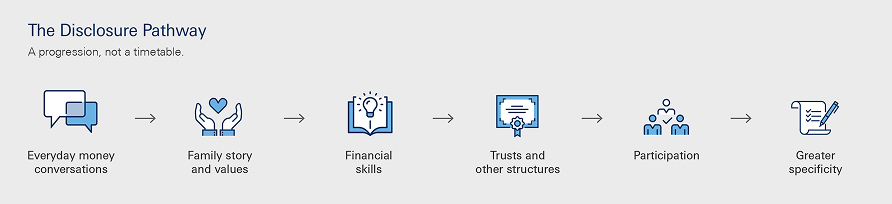
Families can share information gradually. A young person does not need to know the full extent of the family’s wealth to begin understanding the role money plays in the family. Conversations can start with familiar subjects: work, spending, saving, generosity, opportunity, and how the family thinks about money.
As the disclosure pathway illustrates, those conversations can expand over time to include how the family’s wealth was created; the choices, risks, and sacrifices that shaped it; and how the family hopes to use it. Financial education can become more practical as well, with opportunities to learn about investing, charitable giving, trusts and other planning structures, and the roles of trustees, beneficiaries, family members, and advisors.
TITLE
test
As family members learn more, they can also take on a more active role. A rising-generation family member might attend a meeting with a trustee or advisor, participate in a philanthropic decision, join an investment discussion, or assume greater responsibility for personal assets.
The sequence will vary from family to family, and maturity and circumstances may matter more than age alone. In families with several children, there can still be value in establishing a shared baseline of information, even if greater detail and responsibility are introduced at different times. Siblings are likely to compare what they know, and significant differences in what each has been told can create confusion or mistrust.
A gradual approach also gives families room to adjust as conversations unfold. Questions may come up over time, misunderstandings can be addressed before they take hold, and parents can share information as it becomes relevant to decisions a young person is beginning to face. The aim is to give family members enough information, context, and experience to engage thoughtfully with the wealth as it becomes relevant to their lives.
A Conversation with Two Sides
Sharing the Information
For the generation sharing information, it helps to begin with purpose. Before deciding what to say, consider what the next generation needs to understand and what decisions they may soon be asked to make.
That can include being clear about what family resources may make possible, what they do not guarantee, and where independence and personal responsibility remain important. Discussing those expectations directly can leave less room for incorrect assumptions to take hold.
You may also want to be prepared for a range of reactions. Surprise, discomfort, skepticism, indifference, or difficult questions do not necessarily mean the conversation
came too soon or went poorly. An initial response may evolve as family members have time to absorb what they have learned.
Listening is as important as explaining. Questions can reveal assumptions that have already taken hold or show where more context or education may be useful. What you hear can help shape the conversations that follow.
Receiving the Information
Receiving more information can bring its own questions. Family members may need time to process what they are learning, especially when trusts, family entities, or other planning structures are involved.
When Disclosure of Trusts May Not Be Entirely Optional
A trustee’s fiduciary obligations generally include a duty to provide beneficiaries with information about the trust. The scope of that duty depends on the trust agreement and applicable state law.
Over the past several decades, the trend in trust law has been toward greater disclosure. Many states have adopted versions of the Uniform Trust Code, which requires more disclosure than traditional common law.
Required disclosures often begin when a beneficiary reaches the age of majority, usually 18. Before then, information may be provided to a parent or guardian. In some states, a trust agreement may also allow disclosure to be made to a designated representative of the beneficiary, including after age 18.
Required information typically includes a copy of the trust agreement, the identity and compensation of the trustees, an inventory of trust assets and liabilities and their market values, investment performance information, and an accounting of disbursements and distributions.
These requirements should be considered as part of the family’s broader disclosure planning. Ideally, beneficiaries have enough preparation and context to understand the information they may eventually be entitled to receive.
If not, the trust could become a teaching tool for the discussion of the family’s overall wealth.
It can be useful to distinguish among assets owned personally, assets held in trust or through family entities, and resources a beneficiary may be able to access but does not control. Greater knowledge can provide important context, but it does not automatically answer questions about ownership, decision-making authority,
or expectations. Taking time to understand why a structure exists, who has decision-making authority, and what role you may eventually play can be more useful at first than focusing on specific amounts.
Questions are part of the process. Encouraging beneficiaries to ask how a trust works, why a structure was created, what role a trustee plays, or what responsibilities come with being a beneficiary can help replace assumptions with a clearer understanding.
As family members receive more information, they also have an opportunity to build perspective and take on a more informed role over time.
Shaping the Conversation
A more deliberate approach to these conversations can give you time to build understanding among family members before major decisions arrive. Your Bessemer client advisor and wealth planning specialists can help you think through what information to share, prepare family members for initial and follow-up conversations, explain trusts and other planning structures, and coordinate required trust disclosures with your family’s broader communication approach. Where Bessemer serves as trustee, we can also provide beneficiaries with ongoing guidance about the trust and their role in it.
Thoughtful disclosure can help explain intent, clarify expectations, and give family members experience engaging with wealth before they assume greater responsibility or receive more specific information.
You may not be able to control when the next generation begins forming ideas about your family’s wealth, but you can help shape whether those ideas develop from assumptions and fragments of information or from context, experience, and direct conversation.

By coordinating education and retirement savings strategies early in a child’s life, families can create flexible pathways to support education, long-term savings, and broader financial goals.
Some of the most meaningful planning for a child’s future can begin in the earliest days of life. Although education and retirement may be decades apart, decisions made at birth can lay the foundation for both.
529 plans and Trump Accounts can play complementary roles along the way.
Coordinating the two can help families fund education, build long-term savings, and preserve flexibility while creating multiple paths to Roth assets later in life.
Birth and Early Childhood: Laying the Foundation
As soon as a child receives a Social Security number, families can begin funding a 529 plan and a Trump Account. Both offer long-term tax-advantaged growth potential, but they are designed to serve different purposes.
A 529 plan is primarily an education savings account. Qualified distributions are available for a range of education expenses, including certain K-12 costs. This allows families to use the account for eligible expenses before college begins.
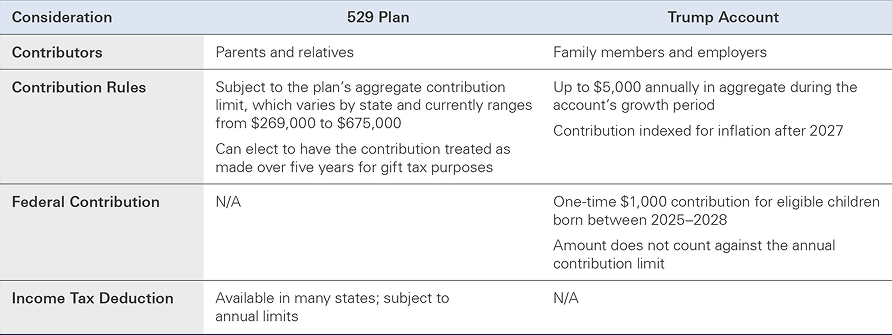
A Trump Account, by contrast, is designed for longer-term savings. Distributions typically cannot begin before the beneficiary turns 18, limiting access during childhood. Once the beneficiary reaches age 18, the account becomes subject to individual retirement account (IRA) rules, providing additional options for the young adult, including the potential to convert the balance to a Roth IRA. The funding rules highlight the central structural difference: a 529 plan can put substantially more capital to work early, while a Trump Account is built around smaller annual contributions. All else equal, that head start can allow a frontloaded 529 plan to accumulate a larger balance over time.
Exhibit 2
test
Gift Tax Considerations
A donor who contributes up to five years’ worth of annual-exclusion gifts to a 529 plan at once can elect to have that contribution treated as made over five years for gift tax purposes. At the current $19,000 annual exclusion, one donor can contribute up to $95,000 at the outset, or a married couple can contribute up to $190,000. During the five-year period, additional gifts from the same donor to that beneficiary could have gift tax consequences.
Families can also coordinate contributors across family members and account types to maximize gift tax exemptions. For example, grandparents might frontload a 529 plan while parents fund a Trump Account, creating complementary sources of support while preserving additional planning flexibility.
The Teen Years: New Opportunities Emerge
As a child enters their teens, another planning opportunity may become available: a Roth IRA. Once a child has earned income, they can contribute to a Roth IRA, subject to the annual IRA contribution limit or their earned income, whichever is lower.
The rules governing the Trump Account also change. Contributions stop on December 31 of the year the beneficiary turns 17, and the account remains inaccessible until age 18. At that point, it becomes subject to IRA rules and can be converted to a Roth IRA. Unlike Roth contributions, a conversion does not require earned income, allowing a young adult to begin building Roth assets even before entering the workforce.
Meanwhile, the 529 plan follows a different timeline. At age 18, most beneficiaries are just beginning college, and those assets may still be needed to fund qualified education expenses.
College and Early Adulthood: Preserving Flexibility
By the college years, families will have greater visibility into a child’s education costs and how much of the 529 plan balance will ultimately be needed. Remember that 529 plans can also be used for graduate and professional school tuition. Keeping the account focused on qualified education expenses can preserve options for later.
If funds remain after education needs become clearer, the 529 plan can provide another path to Roth assets. Under current law, unused 529 funds can be rolled over tax-free to the beneficiary’s Roth IRA, subject to several conditions:
- The 529 plan must have been open at least 15 years
- Contributions and earnings from the preceding five years are ineligible
- Annual rollovers are limited by the Roth IRA contribution limit
- The beneficiary must have sufficient compensation to support the rollover
- Lifetime rollovers are capped at $35,000
Unlike a Trump Account conversion at age 18, 529-to-Roth rollovers generally occur over several years because they are subject to the annual contribution limit.
The Payoff: How the Accounts Come Together
By early adulthood, the two accounts begin to converge on a common goal: building Roth assets.
A Trump Account can be converted to a Roth IRA once the beneficiary turns 18, potentially allowing the conversion to be recognized while the beneficiary is in a relatively low tax bracket. Unused 529 plan assets may move to a Roth IRA later, once education needs are better understood, with rollovers occurring gradually under the applicable rollover limit and $35,000 lifetime cap. Any remaining 529 assets can also continue to fund qualified education expenses or potentially be redirected to another eligible family member by changing the beneficiary.
Used together, the accounts serve different but complementary purposes: the 529 plan can put substantially more capital to work early and offers broad education uses, while the Trump Account can establish retirement assets before a child has earned income. With thoughtful coordination, they can provide a child with both an education fund and a meaningful retirement head start early in adulthood.
Bessemer’s tax professionals can help you coordinate education and retirement savings strategies with your family’s goals, tax considerations, and planning timeline. To learn more, please contact your Bessemer advisor.

Digital accounts and assets may be among the most difficult to access after incapacity or death, but advance planning can help address potential challenges.
As more aspects of our lives move online, digital assets are becoming an increasingly important consideration in estate planning. These assets are electronic records in which you hold a right or interest, such as the information in email, financial, cloud storage, and social media accounts. They could take the form of documents, photographs, and cryptocurrency.
Digital asset planning presents an unusual challenge because the same protections that keep these accounts and their contents secure can make them difficult for others to access or manage. Even your legally authorized representatives may be stopped by a password or verification requirement, device lock, or provider policy restriction.
Fortunately, some providers offer digital tools that simplify this process by allowing users to grant conditional access to their account information. Understanding how these tools work alongside your estate plan, and taking a few practical steps in advance, can help ensure your appointed representatives are prepared to manage your digital legacy.
Key Digital Legacy Planning Concepts
Make and maintain your digital elections. Nearly every state has enacted the Revised Uniform Fiduciary Access to Digital Assets Act (RUFADAA). Under this act, a direction made through a provider’s qualifying online tool generally takes priority over a contrary direction in a will, trust, or power of attorney. That makes coordination important. Review your online designations periodically and seek to align them across all planning materials, so that, for example, an outdated legacy contact designation doesn’t override current instructions in your estate plan.
Grant authority in your estate planning documents. If you have not made a designation through a qualifying online tool, a will, trust, or power of attorney may instead provide relevant instructions. Even when a designation exists, your estate planning documents remain important because they establish who can act on your behalf and the scope of that person’s authority.
Your will and trust should address digital assets, such as cryptocurrency, and your power of attorney should also be as specific as possible in case of incapacity. For example, these can be drafted to grant a person the right to manage or close a social media account. These can also provide consent to access electronic communications, such as email and text messages, which may otherwise be restricted.
Consider using a password manager. Your trusted representatives will need to know what accounts exist and how to navigate them. Even then, having the right password is not always enough. A login attempt from an unfamiliar device may trigger a verification code, sent to a mobile phone that cannot be unlocked. Additional security measures, such as multifactor authentication or passkeys, may pose more hurdles. Even when access is technically possible, using another person’s credentials may violate provider terms or applicable law.
A password manager or similar secure system can help address some of these challenges by keeping your credentials and other verification methods in one place for retrieval when needed. It is important to understand the features of any such system you consider and coordinate instructions with providers’ account management tools and your estate planning documents. The purpose of a password manager is not to encourage someone else to sign in as the account owner, but to help identify the accounts and follow the providers' processes.
- Personal devices can create a separate access challenge. Possession of another person’s iPhone, for example, doesn’t mean it can be unlocked. Apple’s Legacy Contact feature can provide certain account data after death, but not the device passcode or other login information stored in the iCloud Keychain. Repeated incorrect passcode attempts can eventually erase its data if the Erase Data setting is active. Windows and Android devices can present the same problem.
- Self-custodied cryptocurrency requires different precautions. There may be no intermediary to restore access if a private key or recovery phrase is lost, and anyone who obtains either may be able to control the assets.
Digital Tools: No Two Are Alike
Account management tools vary by provider and account type, and they have different access requirements.
For example, Apple currently allows users to name a Legacy Contact who can request certain account data after providing an access key and the accountholder’s death certificate. By contrast, Google has an Inactive Account Manager for personal Google accounts that can automatically release user-selected data to designated contacts after a period of inactivity of your choosing.
Cryptocurrency platform Coinbase currently does not allow a beneficiary to be named for individual accounts. Instead, the person administering the estate generally must submit a death certificate, estate administration documents, identification, and transfer instructions to access the underlying assets.
Curate and Communicate Ahead
Advance planning and coordination can go a long way when quick action is needed. Begin by listing the accounts and devices that would matter most if someone else had to manage your assets and review any available digital tools to make sure your choices align with your estate plan. Then consult the people you have named and your advisors about the role each may play and where the relevant information can be found. Accounts left open and unattended can create opportunities for fraud, so someone should be prepared to contact providers promptly to secure, manage, or close them.
Your Bessemer team can help review these arrangements with you and coordinate any needed estate planning changes with your attorney.
Families are increasingly partnering with intermediary organizations to access on-the-ground insights, capabilities, and connections that can enhance grantee sourcing and collaborative action.
Today's donors have many opportunities to make a difference, but advancing philanthropic goals often requires significant time, coordination, and specialized knowledge. For families balancing multiple priorities, realizing these goals independently can be challenging.
Intermediary organizations can help families manage the complexities of giving while connecting them with new opportunities for collaboration. Often known as regranting organizations, these nonprofit entities offer specialized expertise, established networks, and operational support. Some operate as pooled funds or donor collaboratives, bringing funders together to pursue shared philanthropic goals at greater scale. Why More Donors Are Working with Intermediaries Depending on their needs, donors and families may engage an intermediary to: Expand capacity. Manage research, due diligence, grantmaking, and administration, allowing families to concentrate on strategic priorities. Access new opportunities. Draw on local knowledge and established relationships to explore unfamiliar causes or geographies and connect with nonprofits that may otherwise be difficult to identify. Preserve privacy. Structure giving to protect donor anonymity, particularly when funding a broad portfolio of grantees or where direct donor disclosure adds complexity. Support solutions and respond to urgent needs. Pool resources to test promising initiatives or draw on established networks to respond to time-sensitive challenges. The Power of Shared Purpose: Donor Collaboratives Donor collaboratives bring families and other funders together around shared interests or causes, enabling them to exchange ideas and pursue initiatives beyond their individual capacity. For one donor family affected by a rare genetic disease, collaboration offered a way to advance medical research that had limited commercial funding. Through Bessemer's philanthropic network, the family connected with an independent, nonprofit research partnership established by other affected families. By pooling resources and expertise, participants were able to identify promising opportunities and support a more ambitious research agenda. The partnership also enabled rising generation family members to participate in fundraising and events, connect with peers, and gain leadership experience. Identifying the Right Strategic Partner Intermediary organizations can complement direct grantmaking and other philanthropic activities. Because these organizations vary in mission and approach, families should consider how potential partners align with their priorities. Your Bessemer advisor can help you identify opportunities to work with intermediaries, introduce trusted partners, and evaluate their fit. When appropriate, we can also serve as an intermediary, particularly when donor privacy or anonymity is important.