Build a Living Legacy: An Entrepreneurial Approach to Philanthropy and Family Governance

- Many families are finding that approaches to philanthropy and family governance that once served them well are no longer keeping pace with their evolving needs, generational shifts, or desire for greater participation.
- Entrepreneurial thinking offers a practical and inclusive way forward. It encourages families to experiment, adapt, and work together with greater clarity, purpose, and flexibility.
- At Bessemer, we work with families to strengthen their philanthropic strategy, design more collaborative governance structures, and integrate the two in ways that foster lasting engagement and legacy across generations.
Entrepreneurial thinking is often linked to startups and bold risk-taking. But the mindset itself is not limited to the business world. At its core, it’s about approaching complex challenges with curiosity, adaptability, and a willingness to learn through action. It means testing ideas before committing fully, learning from experience, and improving through iteration.
For families, these principles can be transformative. Entrepreneurial thinking offers a powerful framework not only for how families give, but also for how they work together. It can breathe new life into both philanthropy and governance, helping families remain engaged, aligned, and impactful across generations.
In this piece, we explore how applying an entrepreneurial mindset to philanthropy and governance can help families move beyond traditional models and build a legacy that evolves, adapts, and reflects their values in action.
Why This Matters Now
Families today are navigating increased complexity and generational change. Long-standing approaches to philanthropy and governance — often designed around centralized leadership, long-term plans, and limited participation from rising-leader family members — are being tested by generational change, shifting expectations, and a growing desire for more inclusive engagement.
In philanthropy, younger-generation family members are asking for a seat at the table and want to give in ways that are personal, measurable, and responsive. They bring new priorities and fresh expectations for impact.
Governance, too, is under pressure. Many families are geographically dispersed, span multiple generations, and include a wider range of voices. Structures built for control and stability may not offer enough room for collaboration, adaptability, or shared leadership.
Entrepreneurial thinking offers a shared mindset to meet these challenges. It encourages learning, agility, and inclusion — qualities that help families stay connected, aligned, and impactful across generations.
Entrepreneurial Philanthropy: A Mindset in Action
Philanthropy is a natural starting point for entrepreneurial practices. It offers families a relatively low-stakes environment to try new things, experiment with new models, and build a culture of learning.
The entrepreneurial mindset invites families to treat philanthropy as a living lab — a space to pilot ideas, measure outcomes, and scale what works. Rather than making fixed, one-time commitments, families can test and adapt as they go.
Importantly, entrepreneurial philanthropy mirrors processes that many wealth-creating families already know from business. That familiarity can make it easier to engage across generations and spark collective enthusiasm.
The Philanthropy Innovation Cycle
Key takeaway: Entrepreneurial thinking invites families to approach giving as an ongoing process of learning — starting small, testing ideas, tracking outcomes, and expanding what works.
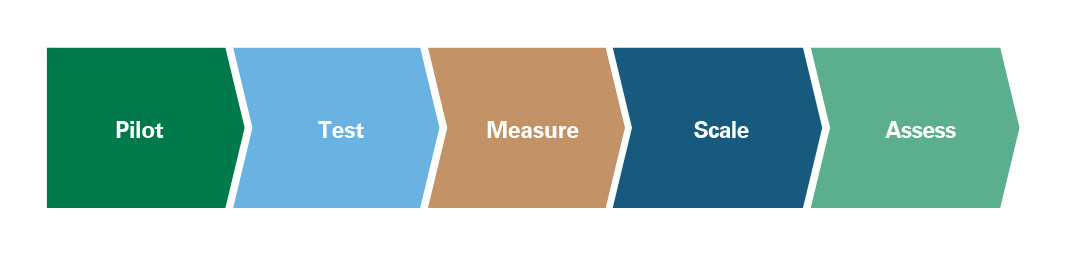
A circular diagram illustrating the Philanthropy Innovation Cycle. The cycle begins with identifying a family’s values and mission, moves through idea generation and strategic planning, then progresses to implementation, measurement of impact, and ongoing learning. The framework emphasizes iteration, adaptability, and continuous improvement in philanthropic decision-making, reinforcing an entrepreneurial approach to giving.
The case study “Experimentation in Philanthropy” illustrates how one family applied this mindset by treating their giving as a portfolio of pilot projects — generating measurable results while meaningfully engaging the next generation.
Case Study: Experimentation in Philanthropy
Treating philanthropy as a portfolio of experiments allows families to learn quickly, engage rising leaders meaningfully, and scale what works.
The Fairchilds, second-generation technology entrepreneurs, launched their family foundation with a familiar model: annual grants to a set of well-known nonprofits. But over time, the next generation began to question whether this approach was truly moving the needle.
Drawing on their business background, the family began treating philanthropy as a space for experimentation. They designated 15% of their annual giving to pilot projects, applying lean startup principles: small bets, short feedback loops, and clear metrics.
One early initiative focused on workforce development. It began as a six-month pilot and, after showing strong early results, was expanded through a partnership with local government and a community foundation. The program has since helped more than 1,000 individuals secure stable employment.
Entrepreneurial Governance: Structures for Renewal
Governance is where an entrepreneurial mindset can reshape how families organize themselves, share responsibility, and adapt over time.
An entrepreneurial approach to governance combines clarity with flexibility. It starts with clear principles and roles but creates space for new voices, fresh thinking, and the ability to evolve as the family changes. It’s not about replacing structure — it’s about designing systems that can grow with the family.
The Family Governance Pyramid
Key takeaway: Strong family governance starts with shared principles that guide policies and translate into consistent practices. This foundation helps families make decisions that reflect their values and remain relevant across generations.
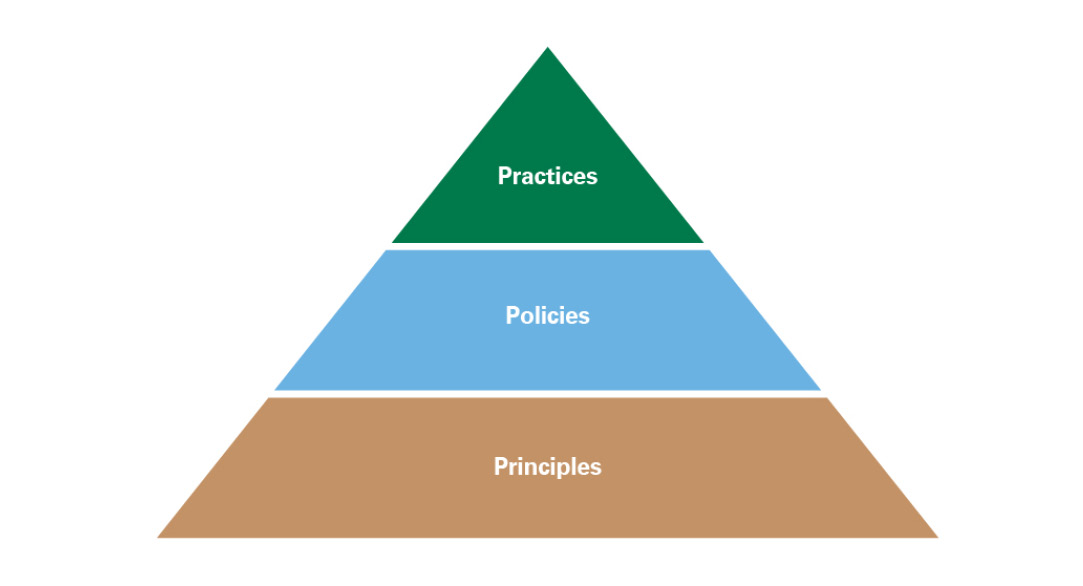
Structured framework describing the Family Governance Pyramid, outlining how principles support policies and translate into practices that guide governance, decision-making, and continuity across generations.
In practice, this might include:
- Clarifying decision rights and responsibilities while inviting broader participation
- Introducing rotating family council seats or innovation funds
- Hosting pitch days to surface new ideas
- Making space for learning and leadership development
These approaches help families model inclusion, creativity, and collaboration. They allow rising leaders to contribute meaningfully even before they take on formal board roles, and they foster a culture in which experimentation is part of how the family learns, governs, and stays connected.
As shown in the case study “Governance That Evolves,” a few simple changes — like rotating council seats and next-gen pitch days — can help families unlock new ideas and spark deeper engagement across generations.
Done well, entrepreneurial governance helps families stay grounded in their values while remaining open to change — supporting both continuity and evolution.
Case Study: Governance That Evolves
Entrepreneurial governance is about creating mechanisms for renewal, experimentation, and inclusion across generations.
The Navarro family, owners of a multigenerational business, found their board dominated by senior members. Decision-making was orderly but static. Younger family members, eager to explore new ideas and expansion opportunities, often felt unheard.
In response, the family reworked its governance structure. They introduced rotating seats on the family council for younger members between the ages of 24 and 35, launched a modest next-gen impact fund, and began hosting an annual pitch day for new ventures.
These small changes had a big impact. One next-gen-led pilot became one of the fastest-growing revenue streams in the business, leading to broader family support for the new programs and deeper engagement across generations.
Legacy as a Living Practice
Legacy is often thought of as what a family leaves behind. But in practice, legacy is something families co-create over time. It is both action and structure: what the family contributes to the world, and the systems of collaboration and decision-making that carry the family’s legacy forward across generations.
Philanthropy and governance are the two primary ways families shape legacy. And when guided by entrepreneurial thinking, these two areas reinforce one another: Philanthropy becomes more adaptive and impactful, while governance becomes more inclusive and resilient.
Philanthropy is how family values are expressed, tested, and refined. It’s often the first opportunity rising leaders have to participate and begin learning stewardship, accountability, and collaboration through direct experience.
Governance provides the structure and continuity to carry that learning forward. When designed with flexibility and participation in mind, it helps ensure that family values are not just preserved but lived and relevant.
One family, for example, updated its charter to include “innovation seats,” temporary roles reserved for younger members to propose new ideas. The change created a visible pathway for next-generation leadership and ensured that evolving perspectives could be heard alongside enduring values.
Together, philanthropy and governance create a cycle of renewal: Each informs and strengthens the other. Families that treat legacy as a living practice — rather than a fixed inheritance — are more likely to stay connected, intentional, and relevant across generations.
How Families Shape Legacy
Key takeaway: When philanthropy and governance inform one another, families create a legacy that is continuously renewed through shared values, evolving leadership, and meaningful engagement.
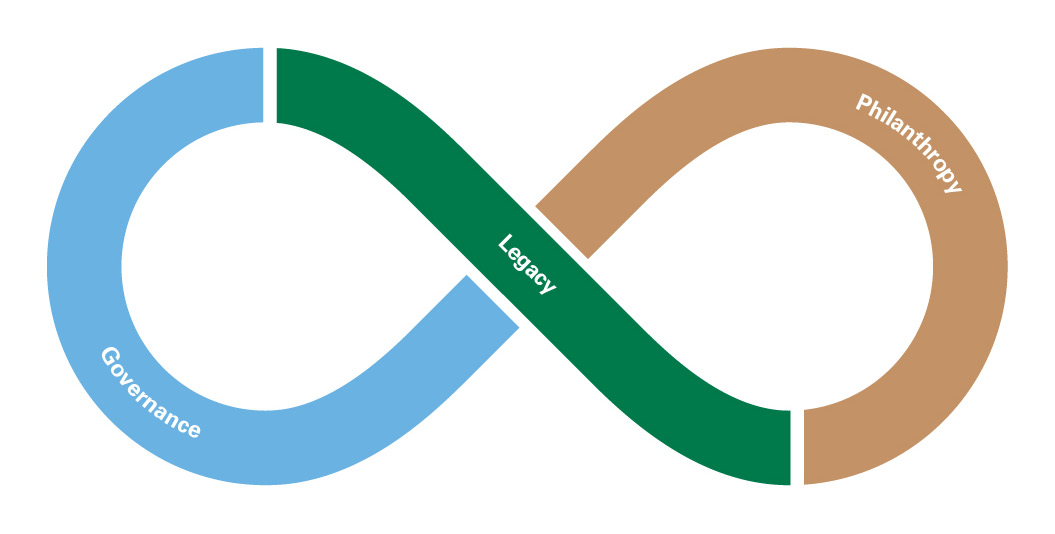
Conceptual overview explaining how family governance and philanthropy operate as a continuous cycle to shape legacy through shared values, leadership development, and sustained engagement.
The case study “Legacy Beyond the Enterprise” shows how one family used a shared platform to support values-aligned ventures and invite new generations to help shape a living legacy.
Case Study: Legacy Beyond the Enterprise
Legacy comes to life when families design structures that allow values, ideas, and leadership to evolve together across generations.
After selling their logistics company, the Liu family began to consider what would carry forward — not just in terms of wealth, but identity. With entrepreneurial roots and a long-standing culture of initiative, they wanted to create a legacy that reflected both where they had come from and what they hoped to become.
Working together, they established a family impact lab, a charitable LLC designed to incubate philanthropic and social enterprise ventures proposed by family members. Proposals are evaluated by a cross-generational committee, based on alignment with family values and long-term sustainability.
One early venture, led by a third-generation granddaughter, involved transforming shipping containers into mobile health clinics. Initially funded by the lab, the project has since attracted external investment and scaled nationally.
For the Lius, the impact lab represents more than a giving vehicle. It’s a shared platform that links values with action, and one that allows the family’s entrepreneurial spirit to evolve through a structure that supports experimentation, inclusion, and legacy in motion.
Families that treat legacy as a living practice — rather than a fixed inheritance — are more likely to stay connected, intentional, and relevant across generations.
How Bessemer Can Help
For many rising leaders, stepping into family philanthropy or governance can feel like entering a conversation that’s already underway. At Bessemer, we help families make space for new voices, fresh ideas, and meaningful engagement across generations.
Whether you’re a rising leader looking for a way to contribute — or a senior family member hoping to encourage participation — we can help you build on what’s working, evolve what may benefit from change, and approach the future with clarity and creativity.
Our advisors work alongside families to strengthen both philanthropy and governance by fostering thoughtful dialogue, helping clarify roles and decision-making, and encouraging a spirit of experimentation. Through strategic guidance, tools, and facilitated conversations, we help families develop effective structures and practices.
You don’t need to make sweeping changes all at once. Even a single step or new idea can open the door to deeper connection, shared purpose, and a legacy that you and your family members create together.
Note: The case studies in this piece are composites based on real client situations. They do not reflect any one individual or family, and all names and identifying details have been altered to preserve confidentiality.
This material is for your general information. It does not take into account the particular investment objectives, financial situation, or needs of individual clients. This material is based upon information obtained from various sources that Bessemer Trust believes to be reliable, but Bessemer makes no representation or warranty with respect to the accuracy or completeness of such information. The views expressed herein do not constitute legal or tax advice; are current only as of the date indicated; and are subject to change without notice. Forecasts may not be realized due to a variety of factors, including changes in economic growth, corporate profitability, geopolitical conditions, and inflation. Bessemer Trust or its clients may have investments in the securities discussed herein, and this material does not constitute an investment recommendation by Bessemer Trust or an offering of such securities, and our view of these holdings may change at any time based on stock price movements, new research conclusions, or changes in risk preference.