A Guide to Cross-Border Giving

- Cross-border philanthropy has grown as families’ lives and charitable interests increasingly extend across borders.
- International giving can involve tax, regulatory, due diligence, and oversight considerations that may not arise in a purely domestic context.
- Families today have a growing range of options for international giving, including public charities, donor-advised funds, intermediaries, private foundations, and more customized structures.
- Structure should follow purpose. The appropriate approach will depend on the family’s philanthropic objectives, the role it wants to play, and the level of oversight it is prepared to assume.
International giving often begins with a personal connection. A school tied to a family’s history. A community encountered through travel or work. A humanitarian crisis that feels impossible to view through a purely domestic lens.
But turning philanthropic intent into effective cross-border giving can involve important tax, regulatory, due diligence, and oversight considerations, many of which vary significantly across jurisdictions. The challenge is deciding not only where to give, but also how to navigate those complexities in a way that supports the family’s philanthropic objectives.
Families today have more pathways for cross-border philanthropy than ever before, ranging from public charities and donor-advised funds to intermediaries, private foundations, and more customized structures. Each approach carries different tradeoffs around control, oversight, administrative complexity, and responsibility.
This article explores several common approaches to cross-border giving and the planning considerations that often shape those decisions.
Why More Families Are Giving Across Borders
Cross-border philanthropy has grown alongside the increasingly international nature of family life. Children study abroad. Businesses operate globally. Family members may live, work, or build relationships in multiple countries over the course of a lifetime.
For some families, international giving becomes a natural extension of long-standing values, faith-based commitments, or personal ties to a particular community or region. For others, it begins with a single institution, relationship, or experience and gradually develops into a more sustained philanthropic focus.
At the same time, many of the issues donors care about have international dimensions that naturally lend themselves to cross-border engagement. Public health, migration, climate resilience, humanitarian relief, and poverty alleviation frequently involve communities, institutions, and funding efforts that operate across borders. Humanitarian emergencies can add particular urgency, as families may wish to act quickly while still allowing time for appropriate due diligence and compliance review.
The infrastructure supporting international philanthropy has also expanded considerably. Historically, international giving often required the scale and administrative capacity of large institutions, private foundations, or families with dedicated charitable infrastructure. Today, public charities with international reach, donor-advised funds, global charitable networks, and specialized intermediaries have made cross-border giving more practical for a broader range of donors.
Yet greater access has also brought greater scrutiny. Governments and regulators around the world have increased their focus on transparency, anti-money laundering controls, cross-border reporting, and the movement of funds across borders. Certain countries or regions may also present additional legal, regulatory, or sanctions-related considerations that require specialized review before charitable funds can be deployed. As a result, families often face more complex decisions around oversight, reporting, and administration than they would in a purely domestic giving context.
Cross-border giving often involves multiple legal, tax, and regulatory systems, which can make philanthropic planning more complex than in a purely domestic context.
For U.S.-based donors supporting organizations abroad, questions may include whether a gift qualifies for a charitable deduction, what due diligence and compliance requirements apply, whether anti-money laundering, sanctions-related, or other restrictions may require review, and who is responsible for monitoring how funds are used. International families supporting U.S. charitable organizations may face a different set of considerations, including coordination across jurisdictions, local tax treatment, currency considerations, and reporting obligations in more than one country.
Due diligence can also become more involved in cross-border settings, particularly when families support smaller organizations, grassroots initiatives, programs in regions facing geopolitical instability, or causes that may present heightened legal, regulatory, or reputational considerations. Depending on the circumstances, that review may include an organization’s governance, financial condition, leadership, local reputation, compliance history, reporting practices, and ability to use and track funds for the intended charitable purposes.
Reputational considerations may also be relevant, especially when philanthropy is closely tied to a family’s identity, values, or legacy. Even well-intentioned gifts can create exposure if funds are misused, if a recipient lacks adequate controls, or if local conditions change. As a result, the structure supporting a gift often becomes an important part of the philanthropic strategy itself.
Questions to Consider
As you consider how to structure your cross-border giving, it may be helpful to begin with a few practical questions:
- What issue, institution, or community are you hoping to support?
- Are you seeking simplicity, flexibility, direct involvement, or a vehicle designed for long-term family participation?
- How much oversight and administrative responsibility are you prepared to manage?
- What legal, tax, and reporting requirements may apply across the relevant jurisdictions?
- How will decisions be made and reviewed over time?
- Who within the family should be involved in the process?
Your answers can help identify the giving structure that best supports your philanthropic objectives.
Matching the Giving Structure to Your Goals
Once your priorities are clear, the next step is selecting the giving structure that best supports them.
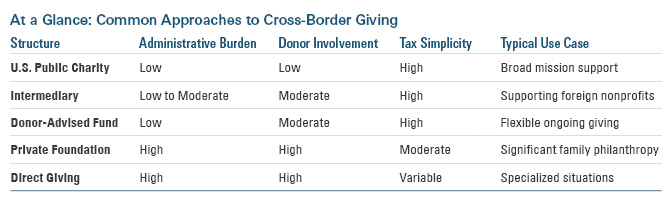
Some structures emphasize administrative simplicity, while others offer greater flexibility and direct involvement. In general, the more influence donors seek over how charitable funds are deployed, the more responsibility they and their advisors may assume for oversight, compliance, and administration.
Supporting U.S. Public Charities With International Reach
For many U.S.-based donors, one of the most straightforward approaches is to contribute to a U.S.-recognized public charity that operates internationally or partners with organizations abroad.
These organizations often already have established compliance procedures, local operational experience, reporting systems, and on-the-ground relationships and infrastructure.
This approach may appeal to families that value administrative simplicity, established oversight systems, and relatively clear tax treatment. In many cases, the charity assumes much of the responsibility for foreign grant administration, due diligence, and ongoing monitoring.
The tradeoff is typically less direct control over how funds are ultimately deployed. The donor supports the organization’s broader charitable mission rather than directing the underlying work in a highly customized way.
For many families, however, that balance is entirely appropriate. They may prefer to rely on organizations with substantial experience operating internationally rather than build separate oversight structures themselves.
Working Through U.S.-Based Intermediaries
Families interested in supporting organizations abroad that are not recognized as U.S. public charities may find a U.S.-based intermediary particularly helpful. These can include specialized intermediary organizations as well as U.S.-based “friends of” organizations established to support particular foreign institutions or causes.
In this model, the donor contributes to a U.S. charitable organization, which then conducts the necessary due diligence, manages compliance requirements, and oversees grants to the foreign recipient organization.
This approach can be particularly useful for families interested in supporting locally led organizations, grassroots initiatives, or smaller organizations with strong regional expertise but limited experience working directly with U.S. donors. It may also appeal to donors who want access to organizations abroad without assuming the full administrative and regulatory burden themselves.
An intermediary can help preserve U.S. tax advantages while assuming much of the responsibility for foreign grant oversight, reporting obligations, and ongoing monitoring. The intermediary becomes an important part of the broader oversight structure surrounding the gift.
When evaluating an intermediary, families may wish to consider the organization’s experience operating in relevant countries, its due diligence and reporting practices, the expected timeline for grants, and the degree of visibility and engagement the family hopes to maintain over time.
Planning in Practice Part 1: Choosing the Right Structure
A family wanted to support organizations advancing educational and economic opportunity throughout Latin America. Rather than making direct grants to numerous local charities, they wanted a way to support locally led organizations while maintaining appropriate oversight and U.S. tax compliance.
Working with Bessemer, the family evaluated several intermediary organizations, including CAF America, Myriad USA (formerly King Baudouin Foundation United States), and The Resource Foundation. In comparing the organizations, the family considered each provider’s regional expertise, due diligence practices, grantmaking process, reporting capabilities, and experience in the countries where the family hoped to give.
Ultimately, the family selected the intermediary best aligned with its philanthropic objectives, providing the oversight, administrative support, and reporting needed not only to administer grants, but also to evaluate the effectiveness of its giving over time.
Donor-Advised Funds and Private Foundations
Donor-advised funds and private foundations may also play an important role in cross-border philanthropy.
Some donor-advised fund sponsors have established international grantmaking capabilities, often working through approved partners and existing review frameworks. This may provide administrative efficiency while allowing families to support charitable work internationally through a familiar structure.
Private foundations may offer greater flexibility and more customized governance, particularly for families engaged in substantial or long-term philanthropy. They can provide a platform for sustained international grantmaking, family participation, and more active oversight.
That flexibility, however, comes with increased responsibility. Direct grants from a private foundation to non-U.S. charitable organizations, rather than U.S. public charities, typically involve the greatest oversight, administrative complexity, and compliance requirements.
For some families, a private foundation may be an appropriate part of a broader cross-border philanthropic strategy. For others, the administrative demands may outweigh the benefits, making a donor-advised fund, intermediary, or public charity a more practical choice.
Direct Giving and Customized Structures
Direct grants to non-U.S. organizations generally place the greatest concentration of responsibility on the donor and their advisors. While this approach may provide little or no U.S. income tax advantages and require careful legal, tax, and compliance analysis, it offers the most direct path to supporting a particular foreign organization or project.
In some cases, particularly for internationally connected families, a coordinated approach may be appropriate — for example, combining a U.S.-based charitable entity, such as a private foundation or donor-advised fund, with an intermediary organization. These approaches can help coordinate cross-border giving and align philanthropic planning with broader wealth and estate considerations, but are generally best suited to families with sufficient scale and advisory support to manage the added complexity.
Planning in Practice Part 2: Measuring Impact
As the family’s giving program matured, the focus shifted from selecting the right structure to understanding whether its philanthropy was achieving the intended results.
Some of the organizations it supported were small, locally led nonprofits with deep regional expertise but limited administrative capacity. Through its intermediary, the family received regular reporting on how grants were being used, the outcomes they were helping achieve, and changes affecting the organizations they supported. Those updates provided greater visibility into how funds were being managed while avoiding additional reporting burdens on the recipient organizations.
Over time, those insights helped the family identify the programs that were making the greatest impact, refine its giving strategy, and make future grant decisions with greater confidence.
When International Families Support U.S. Causes
Cross-border philanthropy does not move only from the United States outward. Internationally based families may also wish to support U.S. universities, hospitals, cultural institutions, community organizations, or other charitable causes.
In these situations, many of the same principles apply, though the planning analysis may differ. A structure that works well for a U.S.-based donor may not produce the same tax or reporting outcomes for a donor based elsewhere. Families may need to coordinate U.S. charitable planning with legal and tax considerations in their home countries.
These dynamics are increasingly common among families of significant wealth. Family members may live in different countries, hold different citizenships, be domiciled in different jurisdictions, or maintain charitable entities in more than one country. When multiple family members or philanthropic vehicles are involved, coordination may be needed not only between donor and recipient organizations but also among family members, advisors, and charitable entities operating under different legal and tax regimes.
The broader principle remains consistent: structure should follow purpose. Families are often best served by first identifying the charitable objective and then determining the most appropriate way to support it across the relevant countries.
A Family Dimension
For some families, international philanthropy can create opportunities for broader family engagement. This may be especially true when family members live in different countries or bring differing cultural experiences and perspectives to the family’s giving.
Shared philanthropic efforts can become a constructive setting for multigenerational participation, collaborative decision-making, and ongoing conversations about family priorities and charitable interests. A family’s connection to a particular region, institution, or issue may also provide a natural focal point for engagement across generations and geographies.
When approached intentionally, cross-border philanthropy can offer families a meaningful way to engage with one another around shared interests and long-term priorities.
Structuring Cross-Border Giving for the Long Term
Cross-border philanthropy can offer families meaningful opportunities to support communities, institutions, and causes beyond a single country. But effective international giving depends on more than geographic reach alone. It often requires careful attention to structure, oversight, administration, and the realities of operating across different legal and regulatory environments.
The appropriate approach will vary from family to family. Some donors may prioritize simplicity and established infrastructure, while others may seek more direct involvement, customized governance, or closer relationships with organizations on the ground. As philanthropic interests evolve over time, the structures supporting that giving may evolve as well.
For families with international ties or globally dispersed family members, cross-border philanthropy may also intersect with broader wealth planning considerations, including estate planning and family governance. Coordinating those conversations thoughtfully can help families build giving strategies that are both effective and sustainable over time.
Bessemer works with families to evaluate charitable structures, coordinate with legal and tax advisors across jurisdictions, identify appropriate philanthropic partners and intermediaries, and integrate cross-border giving into broader wealth planning, family governance, and legacy discussions.
This material is for your general information. It does not take into account the particular investment objectives, financial situation, or needs of individual clients. This material is based upon information obtained from various sources that Bessemer Trust believes to be reliable, but Bessemer makes no representation or warranty with respect to the accuracy or completeness of such information. The views expressed herein do not constitute legal or tax advice; are current only as of the date indicated; and are subject to change without notice. Forecasts may not be realized due to a variety of factors, including changes in economic growth, corporate profitability, geopolitical conditions, and inflation. Bessemer Trust or its clients may have investments in the securities discussed herein, and this material does not constitute an investment recommendation by Bessemer Trust or an offering of such securities, and our view of these holdings may change at any time based on stock price movements, new research conclusions, or changes in risk preference.