Food and Water: Macro Challenges and Micro Opportunities
- The events of this year, including Russia’s invasion of Ukraine, more frequent droughts, and broad-based currency weakness outside the U.S., have put a spotlight on challenges within the agriculture and water space, creating greater risks for the global outlook but also generating investment opportunities.
- The future of food depends on the sustainable production of enough supply to meet the demand of a growing global population. As this demand continues to rise, numerous supply issues must be addressed.
- In this paper, we investigate the state of agriculture and water management, explore innovative solutions that may help secure future food supply, and highlight emerging investment opportunities in these crucial fields.
The Outlooks for Food and Water Are Critically Intertwined
Water is a key component of everyday consumption, not only for human hydration, but also for food production and industry. Agriculture uses the largest share — 70% — of the world’s freshwater resources. Meanwhile, more than half of the water used in agriculture applications is wasted using traditional irrigation methods.1 Furthermore, increased industrialization is driving additional demand for fresh water with industry gaining a larger share of global water consumption. As developing countries continue to industrialize, there is likely to be increased stress on water infrastructure, in our view.
Interestingly, North America appears to be in better shape relative to much of the world in terms of water supply, boasting a favorable water to population ratio; North America has only 8% of the world’s population with 15% of the global water supply, while China is home to 20% of the world’s population, but has only 6% of the world’s freshwater resources (Exhibit 1).
As water demand accelerates with a growing population and agriculture and industrial uses, several factors are challenging the supply side. The confluence of widespread droughts, supply chain complications, and higher energy prices has strained our precariously intertwined global food system. While many point to the Russia-Ukraine conflict as the primary catalyst for higher food and energy prices, many of the dynamics that are pressuring the commodity market were in place well before the war began.
Droughts are the most serious threat to livestock and crops in nearly every part of the world. An estimated 55 million people globally are affected by these natural disasters every year.2 The rising price of natural gas has further complicated the picture as natural gas accounts for 70% to 80% of the production cost of ammonia-based fertilizer. Because ammonia-based fertilizer is imported by most of the largest agricultural producers in the world, rising input costs end up increasing finished product costs. As a result, U.S. food prices have risen nearly 11% over the past 12 months (Exhibit 2). Illustrating the global reach of this phenomenon, Brazil has seen a 13% year-over-year increase in the price of food in the same period, and the price of food and drink in Spain has risen more than 14% on year-over-year basis.
While there are many supply challenges facing global food production, we remain optimistic as many businesses, think tanks, and investors are committed to solving the issues noted above. The perspectives of our internal public equity teams, external sustainability focused managers, and our real assets program give us hope for what the future holds. In the following pages, we feature these three areas of our investment platform and provide insight on some of the businesses working to solve the complex challenges facing global food supply.
Exhibit 1: Global Water to Population Ratios
Key takeaway: North America has a relatively favorable water to population ratio.
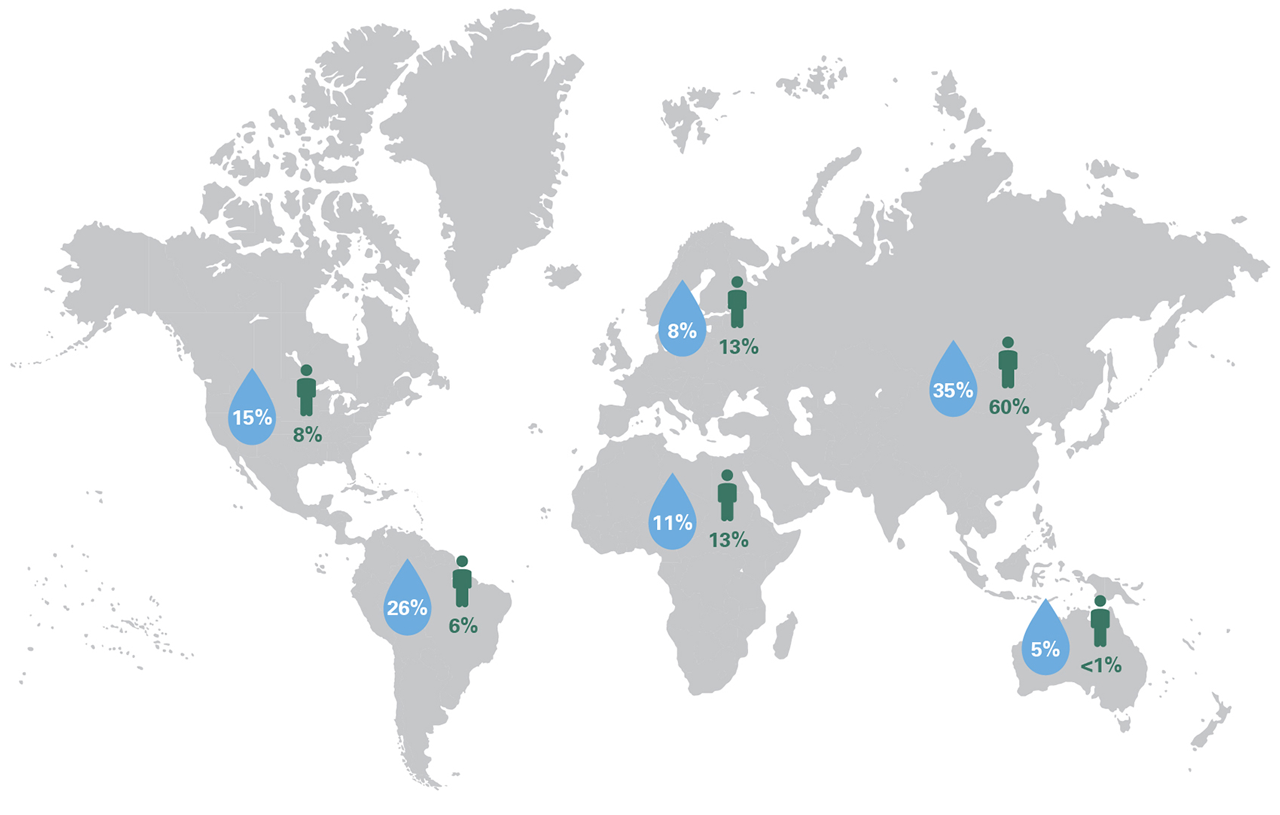
A global map illustrating freshwater resources relative to population across regions, highlighting that North America has a higher share of water relative to its population while Asia and Africa have larger populations with comparatively lower freshwater resources. Data from United Nations sources.
A More Stable Future
While large problems can be daunting, they often drive innovation. And where there is innovation, there is investment opportunity. At Bessemer, we are finding unique investments in companies that offer solutions to help stabilize food production and water management. Our internal portfolio management teams and external manager partners in both public and private markets have been busy uncovering exciting opportunities in the fields of water and agriculture. A notable area of focus is the rapidly evolving field of precision agriculture.
Precision agriculture uses modern technology and data analysis to reduce inputs and/or increase outputs of agricultural products — and it does so sustainably. Following the green revolution of the 1960s and the adoption of mechanized farming in the 1990s, precision agriculture is known colloquially as the “third wave” of modern agriculture. The discipline is vast and penetrates all aspects of crop and livestock production, ranging from the study of soil conditions and weather patterns to targeted irrigation and the optimization of animal health.
Precision agriculture helps solve the never-ending food supply challenge to “do more with less” and is rapidly evolving, aided by advancements in technology such as artificial intelligence (AI) and automation. Both profitability and production can be enhanced through precision agriculture. Using fewer inputs, such as fertilizers and pesticides, boosts profitability, while targeted irrigation, planting, and harvesting enable increased production. In the next sections, we examine some of the innovations and companies that are helping to drive advances in precision agriculture.
North America Fertilizer Index and U.S. Food Prices
Key takeaway: Fertilizer prices have spiked upward, causing food prices to rise.
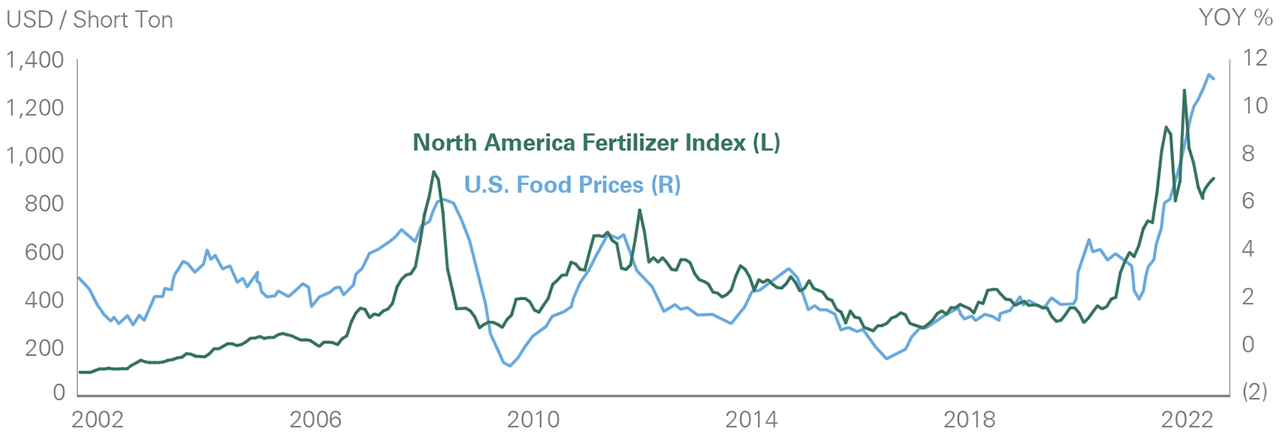
A dual-axis line chart showing the North America Fertilizer Price Index in dollars per short ton on the left axis and the U.S. food price year-over-year percentage change on the right axis, illustrating how recent spikes in fertilizer costs correspond with increases in U.S. food prices through 2022.
Opportunities in Large, High-Quality Public Companies Tackling Food and Water Challenges; Bessemer Equity Team’s Perspectives
Bessemer Trust’s internally managed public equity portfolios invest in a range of economic sectors and global regions. While our investment teams do not target specific themes or “hot” areas, we do consider macro-oriented drivers that we believe will offer long-term tailwinds to companies operating in those areas. There are also cases in which we find related company stocks compelling as our bottom-up research process uncovers attractive earnings growth and valuation fundamentals. Examples of compelling investment areas with broad macro drivers include the agricultural and water sectors. Our challenge as investors is to identify securities of companies that we believe will offer long-term compounding opportunities, not simply attractive end markets. Bessemer Trust also manages a sustainability-focused strategy — Bessemer Sustainable Leaders — a fundamentally driven strategy that uses internal research as the alpha source and sizes positions for optimal relative risk/return while tilting the portfolio toward sustainability leaders.
We believe we have identified several companies that hold leading competitive positions in the agricultural and water sector markets and also offer attractive growth and valuation fundamentals (see sidebar on page 4).
In agriculture, Corteva Inc. and Deere & Co. are owned in our public equity portfolios. Danaher Corp. and Linde are leading water-related companies also held in internal portfolios. We discuss each briefly in the sidebar below.
Selected Internally Managed Portfolio Holdings
Agriculture
Corteva Inc. (CTVA). Corteva is a crop science company that develops and sells agricultural seeds and traits to farmers globally. The company’s research and development efforts broadly acknowledge growing challenges in agricultural markets and try to address these challenges with innovation. Themes Corteva tackles include the following: increasing water scarcity and irrigation challenges, slowly deteriorating soil quality and productivity, and a fixed acreage of fertile land feeding an ever-expanding global population.
Deere & Co. (DE). Deere is the global leader in agriculture machinery, including farm tractors, harvesting combines, a range of farming implements, and, increasingly, an expanding portfolio of “precision ag” solutions that will expand farmer efficiency and productivity. Deere’s strategy seeks to bring information technology to its customers to deliver fuel and fertilizer efficiency and conservation as well as to bolster farm machine productivity.
Water
Danaher Corp. (DHR). Danaher Corp. is a diversified science and technology company operating principally in life sciences and healthcare diagnostic markets. However, the company also operates a leading diversified water diagnostic and conservation business that stands at the leading edge of water treatment and conservation markets. The company’s proprietary technologies measure water consumption and quality for commercial and industrial customers, helping them develop strategies to implement remedial actions such as bolstering water re-use and consequently reducing water consumption.
Linde (LIN). Linde is a leading global industrial gas and engineering company whose business model transforms air and other process gases into applications that help customers become more energy and resource efficient. In addition to enabling a more sustainable energy future, Linde addresses numerous challenges throughout the global water sector by expanding access to clean water. Among its services, the company adds oxygen to wastewater treatment processes, effectively adding plant capacity to treat ever increasing wastewater volumes. Through its desalinization services, Linde carbon dioxide sourced from industrial gas byproducts desalinates sea water to supply safe drinking water into municipal water systems. In 2021, Linde gases enabled access to safe drinking water for more than 225 million people.
Opportunities in the Sustainable Public Equity Space; Bessemer External Managers
While Bessemer considers food, agriculture, and water-related themes across internal portfolios, we also partner with external managers investing in sustainable public equities that complement our internal offerings for clients looking to add targeted exposure. We have been following external managers focused on the sustainable thematic space — including water, food, and agriculture themes — for more than 10 years and know the players well. We are continually looking for new solutions from both newly launched innovative managers as well as long-established managers.
We partner with best-in-class managers who have a consistent philosophy and process and expertise in analyzing the risks and opportunities in the sustainable Food and Water: Macro Challenges and Micro Opportunities landscape. Even these long-tenured firms that are main players in the space continue to enhance their processes and teams alongside the ever-changing industry.
One example of a manager on our external manager solutions platform that embodies what we look for in a partner is Impax Asset Management. A London-based specialist asset manager founded in 1998, Impax invests in opportunities arising from the transition to a more sustainable global economy. In some portfolios, they use a thematic approach with a focus on water, food, and agriculture. Impax invests in water infrastructure and technology, water treatment and utilities, such as desalination, water reuse, leak detection, and automated meter reading. In the food industry, Impax looks for companies involved in improving food safety, promoting healthy and natural food, using fewer and better inputs, and reducing food waste.
Impax — Selected Holdings
Water
IDEX: Approximately 31% of IDEX’s revenue exposure is tied to water distribution and infrastructure. IDEX has a wide portfolio of products largely focusing on water distribution and flow monitoring. This includes products related to areas such as leak detection, water audits, valves, and flow meters. The global demand for water continues to rise as a result of population growth and industry stresses, further exacerbating the gap in water supply and demand. The company provides solutions to monitor water loss and to give greater security to water infrastructure assets to minimize water losses.
Veolia Environment S.A.: Approximately 93% of Veolia’s revenue exposure is tied to water utilities. The company supplies drinking water, provides waste management services, manages and maintains heating and air conditioning systems, and operates rail and road passenger transportation systems. As global populations rise, water becomes an increasingly scarce resource, and Veolia is well positioned to be a solution provider in this area.
Food and Agriculture Royal
DSM: Approximately 59% of Royal DSM’s revenue is tied to sustainable agriculture. The company supplies nutritional ingredients like vitamins and nutraceuticals across well-diversified end markets. DSM helps to improve livestock health and improve efficacy of feed, which serves to lower input-related waste, mitigate against emissions, and limit harmful byproduct cultivation. DSM’s transition from a diversified chemicals producer to a business focused on a more stable and fast-growing nutrition industry is driving higher returns on capital, improved free cash flow generation, and reduced earnings volatility.
Kubota: Approximately 58% of Kubota’s revenue exposure is tied to sustainable food and agriculture. Kubota is the world’s leading manufacturer of small-size tractors and specialist agricultural machinery, such as rice transplanters and harvesters. Kubota’s heritage is in wet field agriculture (rice paddies), and it is well placed to benefit from mechanization of agriculture in South and Southeast Asia, where larger agricultural equipment rivals have less expertise.
Accessing Food and Water Investments and Innovation in Private Markets
Bessemer’s Real Assets team seeks to generate compelling returns by accessing opportunities not available in public markets and partnering with fund managers who bring to bear a longer-term focus, significant influence, and strategic and operating expertise on the privately held assets and companies in which they invest. Key areas of focus for the program are food and agriculture, sectors that have experienced explosive growth as global consumers continue to trend their dietary preferences toward greater variety, higher protein, and healthier foods. The addressable market opportunity is large — the USDA estimated foodservice and food retailing supplied about $2 trillion worth of food in 2021. Pressure from corporate stakeholders toward healthier and sustainably grown foods is likely to increase as ESG factors and commitments to net zero emissions by 2050 continue to influence investor and consumer decisions. The private sector plays an essential role investing equity in project finance, private company growth through commercialization, and consolidation to gain efficiencies.
Today, Bessemer primarily pursues two strategies in the space: (1) We back high-growth companies that foster meaningful positive change in food and agriculture through innovation, productivity, or sustainability to enhance real or financial asset values; and (2) we invest in middle-market businesses and strategically located assets that stand to benefit from institutional management and that are positioned to have a large and important effect on future food or water supply. To achieve target returns, we prefer to invest with teams that have a clear advantage in accessing potential customers, are experienced in driving operational improvements, and that selectively pursue vertical integration to transform natural resources into consumable goods and services. To execute these strategies, we follow a comprehensive selection and review process and partner with leading managers who specialize and are deeply experienced in food and agriculture investing.
Below, we describe current investments made by Bessemer’s managers as well as past investments made by these managers that characterize their investment style, contributed to their experience, and that we evaluated during due diligence. Investing in food and agriculture innovation. To invest in high-growth companies fostering innovation in agriculture, Bessemer has partnered with Aliment Capital. Aliment specializes in investing in companies producing new biological products for large-scale crop protection, among other agriculture categories. See the sidebar on page 6 for several of Aliment’s portfolio companies.
Investing in food and agriculture innovation. To invest in high-growth companies fostering innovation in agriculture, Bessemer has partnered with Aliment Capital. Aliment specializes in investing in companies producing new biological products for large-scale crop protection, among other agriculture categories. See the sidebar on page 6 for several of Aliment’s portfolio companies.
Aliment Capital: Selected Portfolio Companies
AgBiome produces innovative biological products for crop protection including a suite of pest repellants that lower farmers’ carbon footprint, reduce chemical residues on food, and decrease worker exposure to synthetic pesticides. AgBiome’s proprietary fungicide, Howler®, produces natural antibiotics that directly attack pathogens and produce enzymes that break down the cell walls of fungi to prevent attachment of spores to leaves. Notable other investors include Bayer, Syngenta, and Fidelity.
Concentric Ag develops natural biological products targeting the seeds, plants, root systems, and the soil surrounding them. Concentric uses its proprietary microbial consortia technology to combine multiple beneficial bacteria and yeasts into soil and plant boosters that are economical for farmers and greenhouse growers — and, crucially, safe for people and the environment.
Hazel Technologies focuses its product technologies on the controlled release of active ingredients from solid materials to prolong produce shelf life and battle the global problem of food spoilage and waste. One of its technologies turns natural materials into the active ingredients, adding time release to preserve food longer. Its USDA-funded Hazel™ Endure product line is an organic anti-fungal vapor that prevents mold and decay for crops like cherries and avocados by neutralizing the effects of ethylene, a hormone that many fruits and vegetables release that self-triggers continued ripening.
Provivi manufactures pheromones, which are substances that prevent harmful insect attacks on crops by controlling insect populations, by disrupting the mating process, while preserving beneficial insects. Provivi’s patented production method enabled a step change in the cost of manufacturing pheromones. Its products are used by farmers of corn, rice, and other crops. Other investors include Temasek, DuPont, BASF, Bill and Melinda Gates Foundation, and the National Science Foundation.
Bessemer has also partnered with Congruent Ventures, a manager focused on climate solutions, including food and agriculture innovation. The company has invested in robotics, the development of plant-based foods with straightforward ingredients, and logistics management. We detail a variety of Congruent’s portfolio companies in the sidebar below:
Investing in future food and water supply. To focus more directly on the long-term need for food and water supply, Bessemer has partnered with RRG Capital Management (RRGCM), an experienced manager that invests in vertically integrated farming operations.
Congruent: Selected Portfolio Companies
Hippo Harvest is a controlled environment agriculture company that leverages robotics, plant science, and machine learning to grow vegetables sustainably. The company builds next generation greenhouses that are cost competitive with fields using off-the-shelf robotics, sensors, a modified hydroponic growing system, and a proprietary software platform created to enable machine learning optimization in greenhouse operations. Importantly, Hippo Harvest’s greenhouse uses a closed loop and direct-to-root fertilizer and water system, growing produce that requires up to 95% less water than traditional farming. Small robots are used as tractors to care for an array of leafy green crops (like lettuce) and manage tasks including watering, data collection, plant transportation, and cleaning. Hippo Harvest’s system applies machine learning to experiment with the most efficient levels of fertilizer, water, light, and other variables to yield the most vibrant crops possible. In 2021, Amazon took notice and joined the investor group to support Hippo Harvest’s continued growth.
Meati Foods is a company producing a ready-to-cook, all natural mycelium-based protein comparable to grilled or breaded chicken cutlets. What is mycelium? It is the bundle of branching fungi fibers known as mushroom root, which produces energy in the form of sugar and efficiently converts it into a protein that ends up free of sugar, low in cholesterol, and barely processed. Meati products are naturally high in protein, fiber, and vitamins. As prices of traditional meat proteins have recently increased in supermarket aisles, many plant-based products have become more cost competitive. Congruent is supporting and advising Meati’s corporate growth, including the development of its first commercial-scale manufacturing facility. In July 2022, Meati raised $150 million of funding in a deal led by Revolution Growth that included Chipotle Mexican Grill and Canada Pension Plan Investment Board, among others.
More specifically, we chose to partner with RRGCM to pursue land investments in California, Australia, and Chile. These investments typically combine farming operations that generate immediate income and valuable water supply connected to established conveyance systems that can be sold to nearby water districts via transfers to meet agricultural or community needs. Please see the sidebar below for descriptions of several RRGCM portfolio companies. These investments in strategically located assets are positioned to help meaningfully with the future of food and water supply.
Concluding Thoughts
While providing an adequate supply of food for an ever-growing global population is a serious challenge, many businesses, investors, and other organizations are devoting their energies to meeting this challenge head on. We are constantly looking to upgrade our platform and portfolios. Evolving dynamics and ongoing innovation in the food and water sectors, we believe, will continue to provide attractive investment opportunities in the space.
RRG Capital Management: Selected Portfolio Companies
Sun World has a distinguished legacy as an operator of the largest proprietary table grape3 breeding and licensing enterprise in the world. In its 40-plus years of operation, Sun World has filed more than 50 table grape plant patents, and today those varieties are grown in all table grape growing regions of the world. Grapes are a vital source of Vitamin C. RRG sold its investment in Sun World in 2021 to a private equity firm.
Frutura: RRGCM has invested in Frutura, which is creating a vertically integrated produce platform where farmers are part of a global sales network that provides customers with a high-quality supply of produce vital to markets globally, including table grapes, citrus, avocados, mangoes, blueberries, and cherries.
River Garden Farms, an RRGCM investment made in 2021, is strategically located in the heart of California’s Central Valley and covers 12,000 acres of fertile ground farmed for walnuts, rice, wheat, corn, and other everyday grains and nuts. RRGCM manages River Garden Farms to optimize the use of Sacramento River water and groundwater to grow valuable crops and provide opportunities to sustainably transfer water to agricultural and other users in the area as well as farther south in the state. Conservation projects to enhance and monitor wildlife habitats to enhance bird, bee, and salmon populations are ongoing and expanding. RRGCM is also pursuing permanent conservation outcomes via sales.
- Source: United Nations
- https://www.unccd.int/resources/publications/drought-numbers
This material is for your general information. It does not take into account the particular investment objectives, financial situation, or needs of individual clients. This material is based upon information obtained from various sources that Bessemer Trust believes to be reliable, but Bessemer makes no representation or warranty with respect to the accuracy or completeness of such information. Views expressed herein are current only as of the date indicated, and are subject to change without notice. Forecasts may not be realized due to a variety of factors, including changes in economic growth, corporate profitability, geopolitical conditions, and inflation. Bessemer Trust or its clients may have investments in the securities discussed herein, and this material does not constitute an investment recommendation by Bessemer Trust or an offering of such securities, and our view of these holdings may change at any time based on stock price movements, new research conclusions, or changes in risk preference.