The lesson is not simply about investment success. It is about applying the principles that make long-term success possible.
By Michael A. Marquez, President
Entrepreneurs know what it means to beat the odds.
Building a successful business requires resilience, judgment, and vision. It also demands a willingness to live with uncertainty and remain focused on long-term value when others are distracted by the moment. But for many successful founders and business owners, there eventually comes another challenge that can be just as consequential as building the enterprise itself:
What happens after success?
How do you translate the discipline that created wealth into the structures, habits, and values that can help sustain it? How do you prepare your family to benefit from what has been built and understand the responsibility that comes with it? And how do you give future generations guidance without attempting to control a future no one can fully predict?
More than a century ago, Henry Phipps was considering many of these same questions.
The Letter
In June 1911, Phipps, the co-founder of Carnegie Steel and one of the great industrialists of his era, sat down to write a letter to each of his five children. He had already helped build and sell one of the most successful businesses in American history. A few years earlier, in 1907, he and his wife Annie had created Bessemer Trust as their family office, designed to help manage the family’s wealth with discipline and a long-term perspective.
Henry Phipps Letter 1911
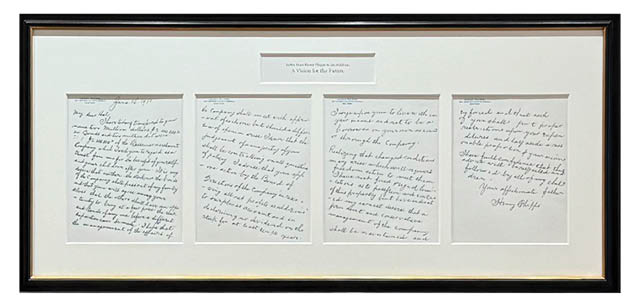
Henry Phipps Letter 1911
In the letter, Henry explained that he had transferred a portion of his wealth to them and asked that they regard it as “a trust … for the benefit of yourself and your children after you.”
He was transferring more than assets. He was conveying a way of thinking about wealth — as family capital to be managed with care and passed forward with a sense of responsibility to future generations.
Henry’s view of stewardship was practical, even operational.
He expressed his desire that the stock and bonds remain within the family and asked his children to agree that any one of them who wished to sell would first give family members the opportunity to buy those interests at a fair price before offering them elsewhere. He wrote that if differences of opinion arose, the judgment of the majority should control questions of policy. He advised them to reserve profits rather than declare dividends for at least 10 years. And he urged them to live within their income, avoid borrowing, place proper limits on expenditures, and lay aside a reasonable portion of what they received.
Taken together, these ideas were the building blocks of continuity: ownership, governance, liquidity, reinvestment, financial restraint, and decision-making.
At the same time, Henry understood that no founder can script the future. One of the most important passages in the letter comes when he acknowledges that “changed conditions may arise” and that future generations would need “freedom in action” to meet them. He did not impose rigid limitations. Instead, he offered guidance rooted in prudence, restraint, and trust.
That balance may be one of the letter’s most enduring lessons. Founders often have strong instincts about how things should be done. They have spent years, perhaps decades, making the decisions that built an enterprise. But sustaining success across generations requires a different kind of leadership.
The guidance Henry offered his children was meant to help meet that challenge. More than a century later, the results speak for themselves. The wealth he passed to his children has remained within the family for seven generations. Sustaining both family bonds and wealth over so many generations is a remarkable achievement. Few families accomplish it. The lesson is not simply about investment success. It is about applying the principles that make long-term success possible.
Why Success Gets Harder Across Generations
As families grow, their affairs become more complex. The number of stakeholders increases. Perspectives diversify. Decision-making becomes more complicated. And over time, the connection to the original effort that created their wealth can fade. Children and grandchildren may inherit opportunity without having lived through the uncertainty and sacrifice behind it.
Families that sustain wealth across generations tend to develop ways to manage this complexity. They communicate openly about priorities and responsibilities. They prepare younger generations for the role they may eventually play as stewards. And they surround themselves with experienced partners who can help them address the evolving challenges of family wealth.
Businesses often face similar dynamics. Many successful companies struggle to endure beyond the founding generation. Those that do tend to share several characteristics: They establish clear governance, develop future leaders, and bring in experienced advisors and professional management as complexity increases.
That connection between business-building and family stewardship is one many entrepreneurs recognize quickly. Today, roughly two-thirds of Bessemer clients are first-generation wealth creators, and more than 70 percent of families who joined us last year were business owners or entrepreneurs.
In my conversations with these clients, I find they understand firsthand the judgment and persistence required to create lasting value. What many are seeking is guidance on the next phase of that journey: how to sustain opportunity, prepare the next generation, and bring the same thoughtfulness to family wealth that they brought to building the business.
Recently, I met with a family that had sold a business they had built over several decades. It was a defining moment for them — the culmination of years of work and sacrifice. Yet their questions were not primarily about markets or economic forecasts.
They were thinking about decision-making, communication within the family, and how to do right by the next generation and the communities and causes they care deeply about.
More than anything, they were looking for perspective and a trusted partner.
The Role of a Family Office
At significant levels of wealth, families often need coordinated support across many areas, among them investment management, estate planning, philanthropy, tax planning, governance, and generational preparation.
Across these areas, a family office can provide the structure, continuity, and experienced guidance families need to make sound decisions and stay focused on what matters most to them.
Bessemer began as one family’s answer to these questions. Henry and Annie Phipps created the firm to serve their family’s needs with discipline and a long-term orientation. Over time, as the family grew and the world became more complex, the family office evolved as well. In 1974, Bessemer opened its doors to nonfamily clients, long before the multifamily office model was widely understood or adopted.
Today, we serve more than 3,000 families, including many of the world’s most successful entrepreneurs and business owners. The questions they ask are often much the same as those Henry Phipps considered in his letter.
Since then, markets, industries, and technologies have evolved in ways Henry Phipps could scarcely have imagined — from the rise of global capital markets to the emergence of venture investing and innovation-driven economies. Families today also face greater complexity across tax and estate planning, philanthropy, and family governance.
Helping families make sense of that complexity while staying focused on what they want their wealth to support over time remains central to our role.
Our purpose is simple: to foster peace of mind.
The most important chapter in a family’s story is not always the one in which wealth is created.
Your Opportunity to Shape Your Legacy
Many business owners spend decades building something extraordinary. Sustaining that success across generations requires a similar mindset, but the work takes a different form. It often involves shaping what comes next for the family: relationships, shared purpose, decision-making, philanthropy, and the preparation of future generations for opportunity and responsibility.
We understand that the most important chapter in a family’s story is not always the one in which wealth is created. Sometimes it is the chapter that follows, when that success is sustained and passed forward with purpose.
Not every founder will write a letter like the one Henry wrote to his children. But every founder leaves guidance of some kind: in the plans they put in place, the conversations they have, the structures they create, and the example they set.
The question is whether that guidance is clear enough, flexible enough, and durable enough to help the next generation carry success forward.
Henry’s letter still offers a simple and powerful reminder: What we build matters. So does what we leave behind.
To learn more about how we work with individuals and families of substantial wealth, please contact us.