Water Utility Bonds: Assessing Risk and Resilience in an Essential Sector

- Water utilities are essential, capital-intensive systems funded largely through customer rates and municipal bonds.
- Water scarcity, PFAS contamination, and aging infrastructure are contributing to higher costs and greater credit differentiation across the sector.
- Bessemer can help evaluate how water utility bonds may fit within your portfolio, with attention to service area economics, system size, liquidity, infrastructure needs, and management quality.
Many of us don’t think twice when we turn on our faucet. However, having clean, reliable water is the product of a large and complex system powered by water utilities across the country.
In this paper, we will explore how municipal water systems operate, their unique challenges, and how we are navigating this complex sector to find high-quality bond investments that can benefit our clients on an after-tax basis.
The Municipal Water Sector
Water utilities, or systems, are responsible for sourcing, cleaning, and distributing safe, reliable water to households and businesses. These systems are either privately owned or operated by public entities, such as local governments or public authorities. In the U.S., approximately 84% of water utilities are government-run, which enables them to issue tax-exempt debt. It’s estimated that bonds issued by water systems account for around $300 billion of the $4.3 trillion municipal bond market.
Revenue for Utilities
Utilities generate most of their revenue by charging customers for the water they use. In many cases, systems are the sole provider of drinking water in a given service area and can set rates without the approval of a state utility commission. However, rates are designed to cover the costs of operating the system and maintaining, upgrading, or expanding infrastructure.
In addition to the monthly water bill, utilities can also collect revenue by charging system development fees. When new buildings or developments are constructed, utilities must install the infrastructure needed to connect these properties to the existing system.
Development fees allow systems to recover the cost of connecting new customers to the system, which can be expensive. This can also help ensure that existing customers aren’t required to subsidize the cost of connecting new users through higher rates.
Two Types of Municipal Water Systems
Retail systems: Systems that provide water to households and businesses in a designated service area. For example, Boston Water provides service to customers within the city of Boston. Erie County Water in New York serves customers in Erie County, as well as Chautauqua, Cattaraugus, Genesee, and Wyoming counties. Upper Santa Clara Valley Water in California serves the city of Santa Clara and other nearby municipalities.
Wholesalers: Systems that secure and treat water on a large scale and then sell it to other utilities. Wholesalers are often formed when multiple retail systems join to pool resources, allowing them to access water sources and invest in infrastructure that would be too costly or inefficient to develop independently. For example, Weber Basin Water Conservancy is a wholesale provider that sells water to 20 municipalities in Northern Utah. These municipalities then sell the water to households and businesses in their respective service areas.
Water Sources
Having a reliable source of water is vital for all water systems. Utilities draw on several sources for their water supply and, in many cases, use a combination of the following:
- Surface water: Water collected from lakes, reservoirs, rivers, and streams, usually originating from precipitation or melting snow. Surface water is relatively inexpensive for systems to collect, but this source is very sensitive to droughts.
- Groundwater: Water that resides below the earth’s surface in natural underground reservoirs known as aquifers. Wells are drilled into these aquifers, and the water is pumped out.
- Purchased water: Untreated or treated water purchased from a wholesaler.
- Desalination: Salt and other minerals are removed from sea or brackish (salty) water to make it suitable for irrigation, industrial uses, and drinking water. For example, to address water scarcity, the San Diego County Water Authority partnered with a private water company to build the Claude “Bud” Lewis Carlsbad Desalination Plant, the largest in the nation.
- Recycled water: Wastewater or stormwater is heavily treated and repurposed for alternate uses such as irrigation and industrial processes. There are more than 500 facilities in the U.S. that recycle water to meet growing demand. El Paso Water is currently building a facility that will produce 10 million gallons of recycled water per day to supplement the city’s drinking water supplies.
Treating Water
Before distribution to customers, water needs to be treated to meet federal and state regulations. How much a system must treat its supply depends directly on the cleanliness of the water source. For example, New York City sources its supply from an area with very clean water. As a result, the system, to date, hasn’t had to clean or filter its supply as extensively as many other water utilities.
Treating water can be very expensive, and these costs can materially affect a utility’s financial performance. Consequently, it may be too expensive for utilities to treat their own water. Wholesalers can help these systems by supplying treated water.
Building Infrastructure
The public water sector is inherently capital intensive. Systems need infrastructure to source, transport, treat, and distribute water to customers. As a result, water utilities must continually maintain and replace existing infrastructure and build new infrastructure.
Water systems have a number of ways to fund infrastructure projects.
When undertaking a project, a utility will most likely fund it with a mix of the following:
Debt: Many systems issue debt in the municipal market to take advantage of tax-exempt rates. Given that many projects have long life spans of 50 years or more, systems structure bonds with maturities that often extend to 30 years.
Cash: Systems partially fund projects or pay for smaller capital expenditures with cash on hand.
Water Infrastructure Finance and Innovation Act (WIFIA): Low-interest, long-term loans provided by the U.S. Environmental Protection Agency (EPA).
State Revolving Funds (SRFs): State-managed loan programs that use a mix of federal and state funds to help utilities finance projects. As water systems repay loans, the funds are recycled to support future projects, thus the moniker “revolving.” States with SRF programs can loan funds only to in-state utilities.
Grants: A number of grant programs are administered by federal and state governments. The grants can be used for a variety of purposes, from infrastructure projects to training and technical assistance.
Three Key Challenges Facing Water Systems
Water utilities face a number of challenges. Three of the most acute problems are water scarcity, per- and polyfluoroalkyl substances (PFAS) contamination, and aging infrastructure.
Water Scarcity
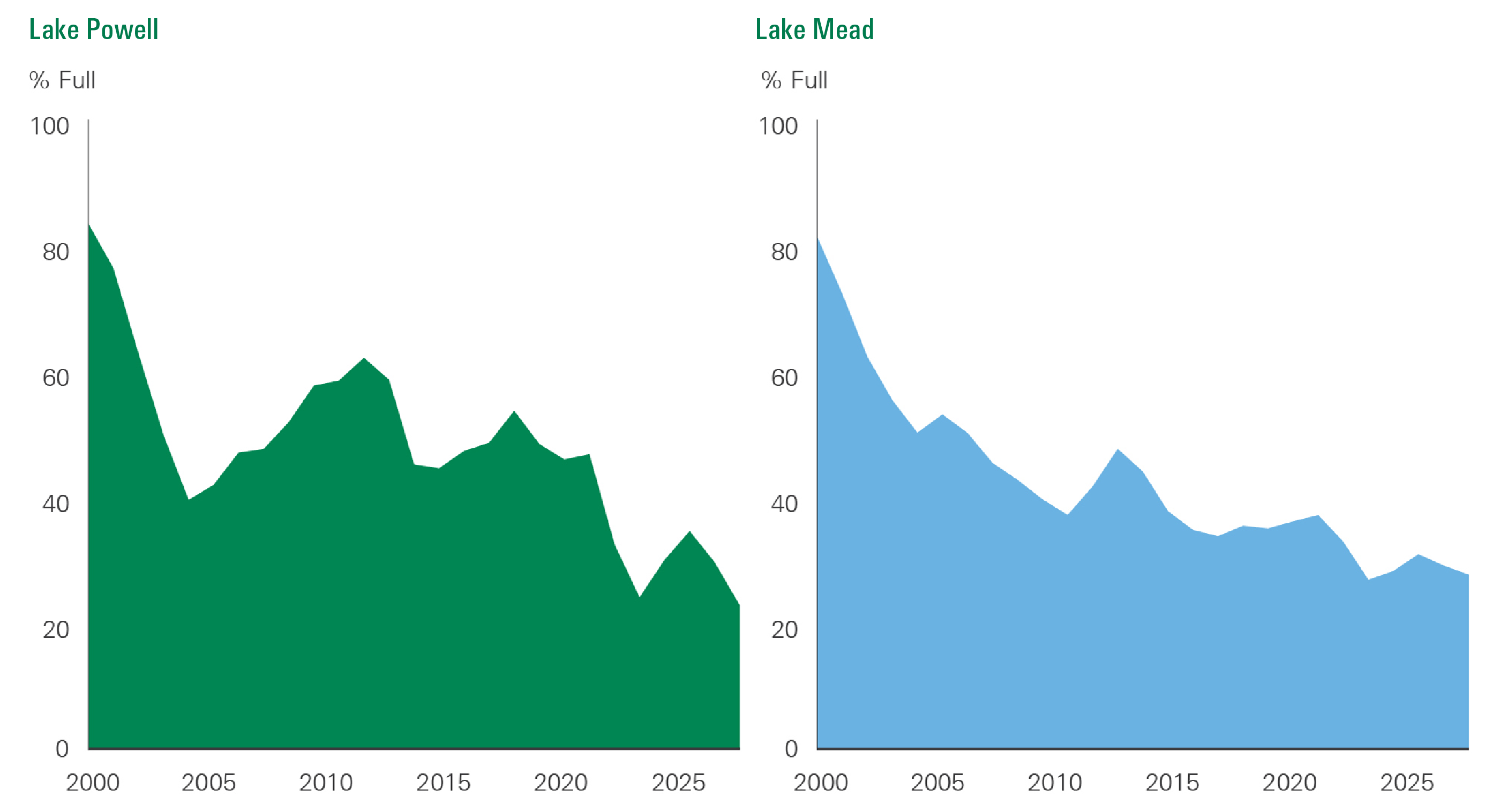
Water scarcity affects regions throughout the U.S. and is particularly critical for systems that rely on the Colorado River, as shown in Exhibit 1. The river spans seven states (Wyoming, Colorado, Utah, New Mexico, Nevada, California, and Arizona) and provides water to about 40 million people. It also supports around 15% of the nation’s farmland.
Since the West was settled, these seven states have fought for the right to use water from the Colorado River. After many years of infighting, the federal government brokered an agreement named the Colorado River Compact in 1922. This agreement divided the states into Upper Basin States (Wyoming, Colorado, Utah, and New Mexico) and Lower Basin States (California, Nevada, and Arizona). The two basins, and the states within each basin, were then allocated a certain amount of river water that each state could draw upon.When the agreement was executed, the allocations were more than sufficient to meet each state’s needs. However, with population and economic growth, the available supply could no longer meet demand. This imbalance, coupled with a long-term drought, has stressed water supplies to all-time lows.
The Colorado River Compact is set to expire at the end of 2026. The states and federal government are currently attempting to negotiate a new agreement, which will likely reduce allocations for some or all of the states.
Water scarcity will only be exacerbated by the continued development of data centers, many of which are located in some of the most water-stressed regions of the country (e.g., Texas, Arizona, and California). In 2023, U.S. data centers consumed around 17 billion gallons of water. Lawrence Berkeley National Laboratory forecasts this demand could increase fourfold by 2028.
As water stress and demand continue to grow, many systems will need to find alternative sources of supply. Potential solutions may include recycled water or desalination. The major drawback of these alternatives is the cost. For example, water from San Diego County’s Claude “Bud” Lewis Carlsbad Desalination Plant costs 160% more than water supplied from the Colorado River.
Exhibit 1: Average Storage Levels for Lake Powell and Lake Mead From 2000–2026
Key takeaway: Two of the Colorado River’s largest reservoirs, Lake Powell (Upper Basin) and Lake Mead (Lower Basin), have seen water levels decrease over the past 25 years. As of September 2026, Lake Powell and Lake Mead were around 22% and 26% full, respectively.
Map of the United States showing the number of public water systems in each state with PFOS concentrations above 4 parts per trillion. States are shaded from white to dark green, with darker shades indicating more affected systems on a scale from 0 to approximately 120. California and Florida are the darkest-shaded states and have the highest counts. Pennsylvania and North Carolina also have relatively high counts, while several other eastern and southern states show moderate levels. Many states across the Mountain West, Midwest, and central United States are unshaded or lightly shaded, indicating few or no public water systems above the threshold.
PFAS Contamination
A major issue for water utilities is exposure to PFAS, or “forever chemicals,” in water. PFAS are a large group of synthetic chemicals that have been used in many industries since the 1950s.
The presence of these contaminants in drinking water has become a public health concern and the focus of increasing regulation over the past decade. As a result, systems have been required to remove these chemicals from water supplies. Affected utilities will likely see higher costs, given the need to invest in new filtration systems or close contaminated water sources.
Nationwide, this could cost systems anywhere from $45 to $90 billion, but costs and exposure vary by region, as shown in Exhibit 2. For instance, many cities in northern Alabama have experienced elevated levels of PFAS contamination due to proximity to a chemical manufacturing plant. These systems are likely to face much higher costs associated with treating heavily contaminated water than systems with lower or no exposure. In many cases, these costs will be passed through to customers’ bills.
Exhibit 2: Public Water Systems With Average PFOS Levels Over the EPA Minimum Contaminant Level (MCL)
Key Takeaway: As part of its fifth Unregulated Contaminant Monitoring Rule (UCMR 5), the EPA collected a number of samples from public water systems all over the country to test for a list of contaminants. This included testing for perfluorooctane sulfonic acid, or PFOS, one of the most common PFAS. In total, the EPA found more than 850 public water systems with average PFOS levels over the agency’s MCL of 4 parts per trillion (ppt). However, contamination levels vary by state with Florida, California, Pennsylvania, North Carolina, New Jersey, Alabama, and South Carolina having the majority of water systems with elevated PFOS levels.

Note: UCMR 5 comparisons to the 4 ppt PFOS MCL are for technical assistance and do not constitute compliance determinations.
Source: U.S. Environmental Protection Agency, fifth Unregulated Contaminant Monitoring Rule
Aging Infrastructure
Water utilities rely extensively on infrastructure to source, transport, treat, and distribute water. Over time, heavy usage and deferred maintenance have led to significant asset depreciation, leaving much of the sector in need of substantial reinvestment. The EPA estimates that the industry requires more than $600 billion in investment over the next 20 years just to maintain current levels of service.
The Sewage and Water Board of New Orleans has witnessed firsthand the effects of underinvesting in infrastructure. From 2015 to 2022, the system did not allocate sufficient funds for critical capital projects. As a result, its infrastructure is now plagued by frequent service outages, recurring boil-water notices, and water leakage accounting for 60% to 70% of its water. On top of that, the utility has a large number of lead pipelines, which are expected to cost around $715 million to replace. In all, the Sewage and Water Board of New Orleans will need to spend about $2.86 billion over the next 10 years to repair and upgrade its infrastructure to provide reliable service to customers.
Investing in Water Utility Bonds at Bessemer: Four Considerations
These challenges, among others, have shaped Bessemer’s investment philosophy for the water sector. Our objective is to identify issuers that operate in economically strong and diverse service areas, maintain solid financial positions, and are better positioned to manage sector risks. Below are a few important factors the municipal research team takes into consideration when analyzing bonds issued by water systems.
Economic Fundamentals of the Service Area
For most water utilities, the largest source of revenue is rates paid by customers for water usage. Therefore, we evaluate the economic attributes of a utility’s service area and customer base. We prefer service areas with stable to growing populations, diverse customer bases, and economies experiencing healthy growth. Utilities serving communities with solid wealth indices are better positioned to adjust rates because customers have a greater capacity to absorb increased costs. In contrast, utilities in lower-wealth communities may have difficulty implementing rate adjustments — and experience a higher percentage of delinquencies — as water bills consume a larger share of customers’ budgets.
The water utility serving Gwinnett County, Georgia, is an example of a system that illustrates these characteristics. Benefiting from its proximity to Atlanta, the county boasts a strong and diverse economy. Consequently, household incomes are above average, and the population is growing. This provides the utility with flexibility to adjust rates to fund its capital plan, including expanding the system to serve the growing population.
Water utilities with scale, ample liquidity, and experienced management may be better positioned to fund capital plans, absorb unexpected costs, and navigate water supply challenges.
System Size
In addition to economic fundamentals, we also consider the size of a utility’s service area and customer base. Larger systems generally benefit from greater flexibility and resilience in their operations and are also less likely to rely on a single water source or concentrated group of customers. These systems can spread costs over a larger customer base, which helps support stable, manageable rate adjustments and competitive rates, all else equal. Further, they generate more revenue on a nominal basis and maintain greater liquidity and reserves.
Denver Water is a large water system that benefits from its size. It serves around 1.5 million people or about 25% of the state’s population. The Board of Water Commissioners is the third-largest landowner in Colorado and maintains a diverse portfolio of water sources, which is beneficial for managing drought conditions. Over the next few years, the board expects to invest around $1.3 billion in infrastructure projects. Given its scale and revenue base, the board is in a good position to absorb these capital expenditures, and unexpected costs are less likely to place material pressure on its financial health or customer base than they would for smaller systems.
Liquidity
Liquidity is very important for utilities in meeting expenses and navigating emergencies. Healthy cash reserves, both on a nominal basis and in relation to expenditures, enable systems to withstand temporary revenue disruptions or cash flow shortfalls without jeopardizing the timely payment of debt service. Ample liquidity also allows utilities to absorb unexpected capital costs without having to issue additional debt or implement unplanned rate increases.
Portland Water in Oregon is currently building a new filtration system to comply with state and federal water quality regulations. The project was originally expected to cost approximately $2.1 billion. However, supply chain issues, labor shortages, and inflation increased costs by around $650 million, or 30%, over the original budget. These overruns could significantly strain less liquid systems. However, Portland Water’s strong cash position has allowed it to absorb these additional costs without materially weakening its financial profile or delaying project timelines.
Management and Leadership
One of the most important factors we consider when analyzing water utilities is the depth and experience of management.
The leadership of the Las Vegas Valley Water District exemplifies what we look for in an experienced team. Given the system’s location, management is very familiar with navigating water supply challenges without materially affecting the system’s financial and operating performance. In response to long-term water supply constraints and drought conditions, the Las Vegas Valley Water District has a rate structure that charges higher rates as a customer’s usage grows. This is beneficial from a conservation perspective as it encourages ratepayers to use less water while also stabilizing system revenue by passing along higher sourcing costs to consumers using above-average volumes of water.
Moreover, management has been recognized for its ability to successfully incorporate drought resiliency into its capital plan to protect the system from future water shortages. These efforts include building a new pipeline to access Colorado River water under stressed conditions and developing alternative water supplies to reduce reliance on strained resources.
Putting It All Together
As noted above, economic strength, system size, liquidity, and management experience are four of the many credit attributes the research team evaluates when selecting water system revenue bonds for Bessemer client portfolios.
The credit review process includes an in-depth assessment of a water system’s operations and financial statements, as well as an analysis of the bonds’ legal covenants and the market factors that could impact their value. We aim to invest in bonds that perform consistently across economic cycles while also delivering attractive tax-exempt returns for our clients.
To discuss how water utility bonds may fit within your broader portfolio, please contact your advisor.
Past performance is no guarantee of future results. This material is provided for your general information. It does not take into account the particular investment objectives, financial situations, or needs of individual clients. This material has been prepared based on information that Bessemer Trust believes to be reliable, but Bessemer makes no representation or warranty with respect to the accuracy or completeness of such information. This presentation does not include a complete description of any portfolio mentioned herein and is not an offer to sell any securities. Views expressed herein are current only as of the date indicated and are subject to change without notice. Forecasts may not be realized due to a variety of factors, including changes in economic growth, corporate profitability, geopolitical conditions, and inflation. The mention of a particular security is not intended to represent a stock-specific or other investment recommendation, and our view of these holdings may change at any time based on stock price movements, new research conclusions, or changes in risk preference.
