
Trump Accounts: A New Opportunity for Multigenerational Wealth Planning

- Congress has created a new type of retirement account for children called Trump Accounts. Beginning in 2026, they offer a new tax-advantaged way to begin investing for children at birth.
- An unusually long investment horizon and the potential for a Roth conversion may provide significant long-term tax advantages.
- This paper examines how Trump Accounts work, where they may complement existing wealth planning strategies, and the key considerations when evaluating whether they make sense for your family.
In the One Big Beautiful Bill Act of 2025, Congress created a new type of tax-advantaged account for children called Trump Accounts, designed to help children begin saving for retirement from birth. But for families looking to build and transfer wealth across generations, Trump Accounts also introduce a new planning opportunity because they combine an unusually long investment horizon with features that may provide benefits extending well beyond childhood.
With annual contributions of up to $5,000 per beneficiary (indexed for inflation), these accounts may complement existing planning strategies such as 529 plans, irrevocable trusts, custodial accounts, or annual exclusion gifting by providing another tax-efficient way to build wealth across generations.
As with any new legislation, implementation guidance from the Treasury Department and the IRS will continue to shape planning considerations. Before making contributions, you’ll also want to consider state tax treatment and how Trump Accounts interact with your broader estate and investment objectives.
How Trump Accounts Work
Trump Accounts are designed to encourage long-term investing for children beginning at birth. Eligible children born between January 1, 2025, and December 31, 2028, receive a one-time federal pilot contribution of $1,000 when the account is established. Children born outside this window and under the age of 18 may still establish an account but are not eligible for the federal contribution. Unlike other retirement savings vehicles, Trump Accounts do not require earned income to make contributions. As a result, families can begin accumulating retirement assets decades before a child enters the workforce.
The accounts are funded with after-tax dollars, investment earnings grow tax-deferred, and the assets generally cannot be accessed before age 18. At that point, the account converts to a traditional IRA under current statutory guidance.
Key Features
Trump Accounts include several notable characteristics:
- Annual contributions of up to $5,000 per beneficiary, indexed for inflation
- Accounts are established by an authorized individual: the child’s legal guardian, parent, adult sibling, or grandparent, in that order of priority
- Contributions may be made by any individual taxpayer
- Employers may contribute up to $2,500 annually for employees’ dependents
- No earned income requirement for contributions
- Investments are limited to qualifying very low-cost U.S. equity index mutual funds or ETFs
- Earnings accumulate tax-deferred
- Accounts can be created and funded for any child age 17 or younger
- Assets remain invested until age 18
- Contributions may require the filing of a gift tax return
- Only one Trump Account may exist for each eligible child
- The child is the owner of the Trump Account
Opening a Trump Account
Opening a Trump Account is a two-step process. First, an authorized individual elects to establish the account by filing Form 4547 with a federal income tax return or electronically through an IRS Individual Online Account or the Trump Accounts app. If more than one election is submitted for the same child, the person whose election is processed first by the IRS becomes the account’s responsible party.
Once the election is processed, the Treasury Department provides instructions for completing the account setup. Robinhood serves as the brokerage firm and initial trustee, while BNY serves as the Treasury Department’s financial agent for the program. At launch, contributions are automatically invested in a very low-cost S&P 500 index ETF. Additional guidance is expected on procedures for transferring Trump Accounts to other trustees, including which firms may serve in that capacity.
Planning Opportunities
Annual contribution limits are relatively modest, but much of their value lies in the account’s unusually long investment horizon.
Because contributions can begin at birth, Trump Accounts may provide nearly two decades of tax-deferred growth before the beneficiary reaches adulthood. Combined with decades of additional retirement investing, that early start can significantly enhance the long-term benefits of compounding.
Trump Accounts also make it possible to begin building retirement assets for children before they have earned income. Traditional and Roth IRAs generally require wages or self-employment income. Trump Accounts remove that requirement, allowing retirement savings to begin much earlier.
For families planning across generations, that represents a meaningful addition to the planning toolkit.
Example 1: Building Wealth Before Adulthood
Consider a child born in 2026 who qualifies for the federal pilot contribution. Assume:
- Initial government contribution: $1,000
- Annual family contributions: $5,000
- Contributions made every year through age 17
- Hypothetical annual investment return: 7.2%
Under these assumptions, the account could grow to approximately $203,000 by age 18.
While actual investment returns will differ, this example demonstrates the potential benefits of beginning long-term investing early.
The Roth Conversion Opportunity
One of the more compelling planning considerations arises once the beneficiary reaches age 18. Because the account converts to a traditional IRA at that point, families may wish to evaluate whether converting those assets to a Roth IRA could produce favorable long-term tax results.
The potential benefits include:
- Paying federal income tax while the beneficiary may be in a relatively low tax bracket
- Locking in decades of future tax-free investment growth
- Eliminating future income tax on qualified Roth distributions
- Creating retirement assets that may continue compounding tax-free until the account is depleted
Example 2: The Value of an Early Roth Conversion
The potential long-term benefit of Trump Accounts becomes even more apparent when considering a Roth conversion.
Let’s use the same assumptions from Example 1: An initial government contribution of $1,000, annual family contributions of $5,000 every year through age 17, a 37% federal tax rate, and a hypothetical annual investment return of 7.2%.
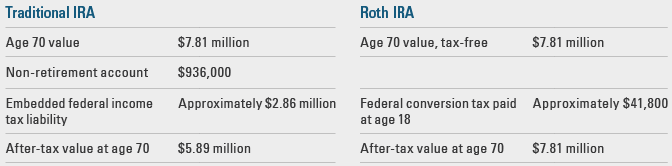
Potential after-tax advantage of the Roth strategy: Approximately $1.92 million
For comparison purposes, the Traditional IRA scenario assumes that the $41,800 that would otherwise be used to pay the Roth conversion tax remains invested in a taxable non-retirement account, earning a hypothetical 6.1% annual after-tax return. The $936,000 represents the future value of that account. The illustration assumes federal taxes only. If state taxes apply, the potential benefit of the Roth conversion would increase.
The potential benefit of the Roth strategy may continue to increase beyond age 70. Traditional IRAs are also subject to required minimum distributions beginning at age 75 under current law, while Roth IRAs are not subject to required minimum distributions during the original account owner’s life.
Note: The 7.2% annual pre-tax rate of return and the 6.1% annual after-tax rate of return used in both examples are intended solely to demonstrate the potential impact of long-term compounded growth. Actual investment performance and tax outcomes will differ. A 37% tax rate was reflected in this example. Roth conversions at a lower marginal tax bracket would see an increased outcome.
Rather than deferring taxation until retirement, a Roth conversion effectively shifts the tax burden forward — often at a lower marginal tax rate — in exchange for the potential for decades of tax-free growth. The optimal timing of a Roth conversion will depend upon each beneficiary’s income, future tax expectations, and available liquidity to pay the conversion tax.
For many families, the years immediately following college — or before a beneficiary begins a high-income career — may provide an attractive window for evaluating a Roth conversion.
Although every situation is unique, converting during relatively low-income years may reduce the tax cost while maximizing future tax-free appreciation.
How Trump Accounts Fit Within a Broader Wealth Strategy
Trump Accounts are not intended to replace existing wealth planning strategies. Rather, they are best viewed as another planning tool that may complement education funding, gifting, and trust and estate planning strategies. For many families, the greatest value will come from considering how Trump Accounts fit within an integrated wealth plan.
Potential applications include:
- Coordinating with existing strategies. Trump Accounts can complement, rather than replace, existing planning approaches. Families saving for education, for example, may continue using 529 plans to fund anticipated education expenses while separately contributing to Trump Accounts to begin building retirement assets.
- Family gifting opportunities. Parents, grandparents, and other family members who already make annual gifts may choose to direct a portion of those gifts to Trump Accounts. Doing so may help establish long-term retirement assets while supporting broader wealth transfer objectives.
- Building long-term financial flexibility. Beginning retirement savings early may provide beneficiaries with greater financial flexibility over time. By establishing dedicated retirement assets early in life, families may preserve other assets for future goals as financial needs evolve, whether those include purchasing a home, pursuing entrepreneurial opportunities, or other priorities.
- Employer contributions. Business owners may also consider employer contributions for employees’ dependents, where appropriate. Such contributions may enhance employee benefits while supporting employees’ long-term financial well-being.
Planning Considerations
Whether Trump Accounts are appropriate for your family will depend on your individual circumstances and broader wealth planning objectives. As with any planning decision, you’ll want to consider these accounts alongside your existing investment, tax, estate, and education planning strategies.
Key considerations include:
- Eligibility for the federal pilot contribution
- Coordinating contributions with broader gifting and estate planning strategies
- The potential timing of a Roth conversion
- State income tax treatment
- How Trump Accounts complement existing trusts, education funding, charitable planning, and other wealth transfer strategies
Trump Accounts offer families a new way to begin building retirement assets early in a child’s life, with the potential for those assets to grow over decades. If you’d like to explore whether these accounts could make sense for your family, your Bessemer advisor, together with Bessemer’s tax and wealth planning specialists, can help you evaluate how these accounts may support your long-term planning goals.
This material is for your general information. It does not take into account the particular investment objectives, financial situation, or needs of individual clients. This material is based upon information obtained from various sources that Bessemer Trust believes to be reliable, but Bessemer makes no representation or warranty with respect to the accuracy or completeness of such information. The views expressed herein do not constitute legal or tax advice; are current only as of the date indicated; and are subject to change without notice. Forecasts may not be realized due to a variety of factors, including changes in economic growth, corporate profitability, geopolitical conditions, and inflation. Bessemer Trust or its clients may have investments in the securities discussed herein, and this material does not constitute an investment recommendation by Bessemer Trust or an offering of such securities, and our view of these holdings may change at any time based on stock price movements, new research conclusions, or changes in risk preference.