
The New York City Pied-à-Terre Surcharge: Key Planning Considerations

- Effective July 1, 2026, New York City’s new, phased pied-à-terre surcharge applies to certain high-value residential properties that are not used as a primary residence.
- Whether the surcharge applies, and how it’s calculated, depends on several factors, including the property’s classification, value, ownership structure, and use. The rules for condominiums and co-ops also change beginning in 2028.
- If you own a high-value New York City residence, reviewing ownership, occupancy, and supporting documentation can help you understand your potential exposure and determine whether a primary-residence exception may be available.
A new pied-à-terre surcharge is now in effect, adding another planning consideration for owners of certain high-value New York City residential properties.
While the rules are detailed, the planning questions are relatively straightforward. Does the surcharge apply to your property? Is a primary-residence exception available? And if so, do you have the documentation to support that position?
For many owners, the answers will be clear. Others, particularly those with trust or entity-owned property, family occupancy arrangements, or high-value condominiums and co-ops, may benefit from a closer review.
The surcharge’s effective date is only part of the story. An important change to the valuation rules for condominiums and co-ops is scheduled for 2028, making this a planning issue that extends beyond the law’s initial implementation.
In this article, we highlight the rules most likely to affect owners and the planning questions they may wish to consider.
Could the Surcharge Apply to Your Property?
The surcharge generally applies to certain high-value New York City residential properties that are not used as a primary residence. Whether a property falls within its scope begins with two questions:
- What type of property is it?
- How is that property valued under the law?
The legislation distinguishes between Class One homes — generally one-, two-, and three-family residences — and Class Two condominiums and co-ops.
During the current phase of the law, those property types are subject to different valuation thresholds and surcharge rates. Beginning in 2028, however, the valuation methodology for condominiums and co-ops is scheduled to change. For owners of those properties, that transition could have a meaningful impact on future surcharge exposure.
You may wish to take a closer look if you own:
- A high-value New York City townhouse or other one-, two-, or three-family home that is not your primary residence
- A condominium or co-op used as a second home
- A residential property held through a trust, LLC, partnership, corporation, or other entity
- A residence occupied by an immediate family member
- A property leased to a tenant or subtenant
- A cooperative apartment where surcharge billing may involve the cooperative corporation
New York City Pied-à-Terre Tax: Does the Surcharge Apply?
The surcharge applies to covered NYC residential properties that are not a primary residence, beginning July 1, 2026; the tax is scheduled to be repealed on June 30, 2031, unless extended.
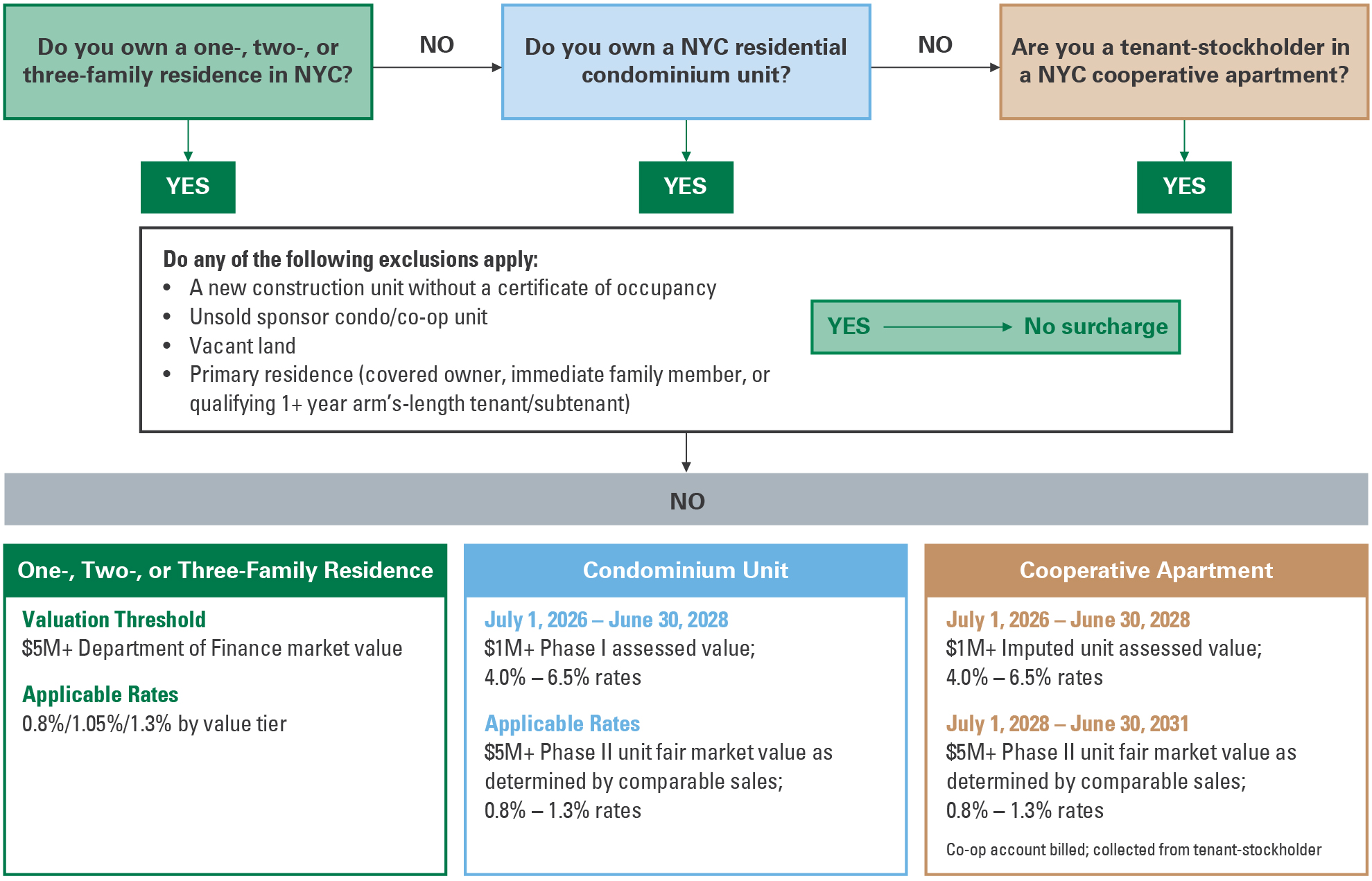
Flowchart for determining whether the New York City pied-à-terre surcharge applies. The process begins by asking whether the property is a one-, two-, or three-family residence, a residential condominium, or a cooperative apartment in New York City. If the answer is yes to any property type, the chart asks whether an exclusion applies, including a new construction unit without a certificate of occupancy, an unsold sponsor condominium or cooperative unit, vacant land, or a qualifying primary residence occupied by the owner, an immediate family member, or a tenant or subtenant under a qualifying lease of at least one year. If an exclusion applies, no surcharge is due. If no exclusion applies, the chart summarizes the applicable rules by property type. One-, two-, and three-family homes are subject to the surcharge when the Department of Finance market value is at least $5 million, with rates of 0.8%, 1.05%, or 1.3% depending on value tier. Condominiums are subject to Phase I rules from July 1, 2026, through June 30, 2028, using assessed values of at least $1 million and rates of 4.0% to 6.5%; beginning July 1, 2028, Phase II uses comparable-sales fair market values with a $5 million threshold and rates of 0.8% to 1.3%. Cooperative apartments follow the same transition, using imputed unit assessed values during Phase I and comparable-sales fair market values during Phase II, with co-op accounts billed and the surcharge collected from the tenant-stockholder.
Not every property will be subject to the surcharge. Certain categories of property generally fall outside its scope or are specifically excluded under the legislation. Because those determinations often depend on a property’s classification and use, however, it is worth confirming the facts before concluding that an exclusion applies.
How the Surcharge Is Calculated
The law uses different valuation rules depending on the type of property you own — and, for condominiums and co-ops, those rules are scheduled to change beginning in 2028. Exhibit 1 summarizes the applicable thresholds, valuation methods, and rate ranges. Note that, at the outset, the tax rate is much higher for condos and co-ops since the assessed value of these residences is normally a fraction of their fair market value. Beginning in 2028, those properties are scheduled to be valued under a different methodology that considers comparable sales and aligns more closely with the approach used for one-, two-, and three-family homes.
Exhibit 1. Property Types, Valuation Thresholds, and Surcharge Rates
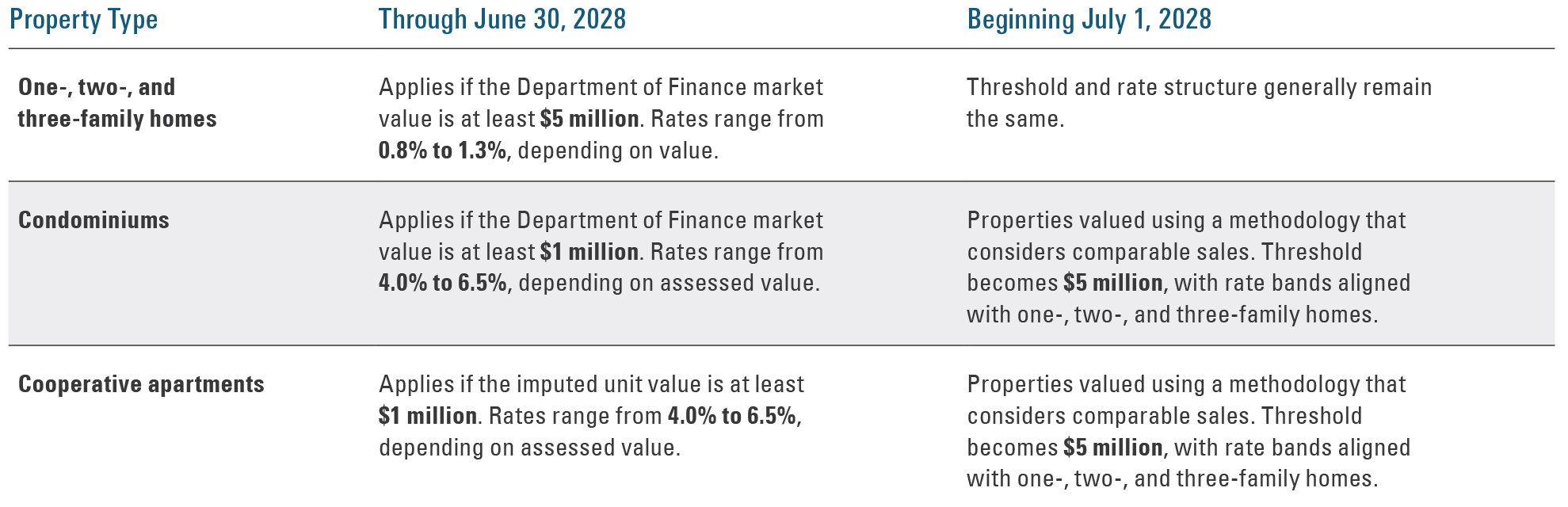
Table comparing the New York City pied-à-terre surcharge by residential property type before and after July 1, 2028. For one-, two-, and three-family homes, the surcharge applies to Department of Finance market values of at least $5 million through June 30, 2028, with rates ranging from 0.8% to 1.3%; beginning July 1, 2028, the threshold and rate structure remain the same. For condominiums, through June 30, 2028, the surcharge applies to assessed values of at least $1 million with rates from 4.0% to 6.5%. Beginning July 1, 2028, qualifying units are valued using comparable sales, the threshold increases to $5 million, and the rate bands align with one-, two-, and three-family homes. Cooperative apartments follow the same transition: through June 30, 2028, the surcharge applies to imputed unit values of at least $1 million at rates of 4.0% to 6.5%; beginning July 1, 2028, comparable-sales valuation is used, the threshold increases to $5 million, and rates align with one-, two-, and three-family homes. Source: New York State Assembly Bill A10009-C and Senate Bill S9009-C.
For some owners, that transition could affect how their property is valued and, in turn, whether the surcharge applies or how much is owed. As a result, understanding the scheduled changes may be just as important as understanding the rules currently in effect.
The Primary-Residence Exception
For many owners, the most important question won’t be how the surcharge is calculated but whether it applies at all.
The law includes an exception for certain properties used as a primary residence. Whether a property qualifies depends on the specific facts and the applicable statutory requirements. Because those requirements differ depending on the property’s ownership and occupancy, the analysis is not always limited to the titled owner. Examples of situations in which the exception may be available are summarized in the accompanying sidebar.
Because eligibility depends on the specific facts, owners should avoid making assumptions based solely on who holds title. How the property is owned and used, who occupies it, and how those facts are documented can all influence whether the exception applies.
When the Primary-Residence Exception May Apply
The surcharge generally does not apply if the property qualifies as a primary residence under the law.
Depending on the circumstances, primary-residence treatment may be available when the property is occupied by:
- The owner
- The immediate family member of the owner
- A qualifying tenant or subtenant
- Certain beneficial owners or majority owners of property held in trusts or other entities
Whether the exception applies depends on the specific facts and the applicable statutory requirements.
Planning Considerations
The new surcharge may affect owners differently depending on how a property is owned and used. While the applicable rules are technical, several common situations may warrant a closer review.
Owners of Condominiums and Co-ops
For owners of condominiums and co-ops, the scheduled changes to the valuation rules beginning in 2028 deserve particular attention. Because the valuation approach is scheduled to change, owners should consider not only how their property is treated under the current rules but also how the later transition could affect future surcharge exposure.
Family Occupancy
The law’s primary-residence exception may apply in situations where a property is occupied by an immediate family member rather than the titled owner. Because eligibility depends on the specific facts, owners should carefully review both the occupancy arrangements and the documentation supporting them.
Leased Property
A property leased to a tenant or subtenant may also qualify for the primary-residence exception if the applicable statutory requirements are satisfied. For example, the law generally requires the property to be occupied by a natural person under a bona fide arm’s-length lease or permitted sublease for a term of at least one year. Owners should review the terms of the lease, the property’s use, and the documentation supporting the tenant’s occupancy.
Trust and Entity Ownership
The law includes special provisions for property owned through trusts and other entities. Depending on the ownership structure, beneficial owners or majority owners may be relevant in determining whether the primary-residence exception applies. Reviewing ownership records and governing documents can help clarify how the rules apply in these situations.
Cooperative Apartments
Owners of cooperative apartments should also be aware of the surcharge’s administrative requirements. Because the surcharge is billed through the cooperative corporation, early coordination regarding notices, collection procedures, and related documentation may help avoid confusion if the surcharge applies.
New York City Residents
Owners who are New York City tax residents generally should not be subject to the surcharge if the property qualifies as their primary residence. However, it remains unclear whether statutory residents will qualify for the exception when the New York City residence is not their domicile. Bessemer’s tax advisors can help evaluate how the rules apply in those circumstances.
Documentation Matters
If a property’s eligibility for the primary-residence exception is ever questioned, documentation will be important.
The Department of Finance may require certifications and supporting documentation to establish that a property qualifies for the primary-residence exception. It also has authority to audit submissions for up to six years and may impose penalties for materially inaccurate or misleading submissions made negligently or in bad faith.
Owners should pay close attention to any notices they receive, applicable response deadlines, and future Department of Finance guidance. For the initial fiscal year, the Department of Finance is expected to issue notices on or about August 1 to owners of properties it has determined are not primary residences. Owners who disagree with a determination must respond by August 30 and provide documentation supporting any applicable exemption.
For properties other than cooperative apartments, the surcharge is added to the property’s tax statement of account. For the initial fiscal year, payment is due with the second semiannual real property tax installment.
Supporting Documentation
Documentation requirements vary depending on the property’s ownership and use, and additional guidance from the Department of Finance may further clarify what information is required in particular situations. Examples of records that may be relevant include:
- New York State resident income tax returns
- STAR exemption or homeowner tax credit records
- Occupancy records, including mailing addresses and utility records
- Lease or permitted sublease agreements
- Documentation establishing family relationships, where applicable
- Trust agreements, entity governing documents, and ownership records
Conclusion
The new pied-à-terre surcharge will have little impact for some owners and more significant implications for others. Understanding how the rules apply to your property can help you determine whether and to what extent the surcharge affects you.
If you have questions about how these rules may apply to your circumstances, Bessemer’s tax advisors are available to help.
The information and opinions contained in this material were prepared by Bessemer Trust and are for informational purposes only. They do not take into account the particular investment objectives, financial situation, or needs of any individual client. This material is based upon information obtained from various sources that Bessemer Trust believes to be reliable, but Bessemer makes no representation or warranty with respect to the accuracy or completeness of such information. The views expressed herein do not constitute legal or tax advice; are current only as of the date indicated; and are subject to change without notice. Bessemer Trust does not provide legal advice. Please consult with your legal advisor to determine how this information may apply to your own individual situation. Whether any planned tax result is realized by you depends on the specific facts of your own situation at the time your taxes are prepared.