Choosing a Tax-Efficient Business Entity: Key Considerations Under OBBBA

- OBBBA preserved and expanded several business tax provisions, creating new planning considerations for business owners evaluating their entity structures.
- Expanded QSBS benefits may make C corporations more attractive for growth-oriented businesses, while the extension of the Section 199A deduction preserves important advantages for pass-through entities.
- Choosing the appropriate structure requires weighing potential tax benefits alongside capital needs, expected profitability, liquidity requirements, and long-term business plans.
The One Big Beautiful Bill Act (OBBBA) preserved and expanded several business tax provisions originally enacted under the Tax Cuts and Jobs Act (TCJA). These changes have important implications for business owners evaluating how to structure their companies, whether establishing a new business or reconsidering an existing one.
Beyond liability protection, governance, succession planning, and access to capital, business owners should consider several tax-related questions:
- Whether a business should operate as a C corporation or pass-through entity;
- Whether the business may qualify for qualified small business stock (QSBS) treatment;
- Whether owners can benefit from the Section 199A qualified business income (QBI) deduction;
- Whether qualified opportunity fund (QOF) or qualified rural opportunity fund (QROF) incentives may apply; and
- Whether an existing entity structure should be reconsidered.
Current Low Corporate Income Tax Rate
The TCJA reduced the federal corporate income tax rate from 35% to 21%, making C corporations more attractive in many circumstances. OBBBA retained this reduced rate.
Historically, business owners often avoided C corporations because corporate earnings were subject to two levels of taxation. Income earned at the corporate level was taxed first to the corporation and then taxed again when distributed to shareholders as dividends. Prior to TCJA, the high 35% corporate tax rate significantly reduced the amount of after-tax income available for reinvestment or distribution.
The current 21% rate changes that analysis. Where earnings are expected to be retained within the business and reinvested for growth rather than distributed currently, the lower corporate tax burden can create a long-term compounding advantage. Businesses anticipating significant appreciation or an eventual sale may therefore find the C corporation structure considerably more attractive than under prior law.
Common Business Entity Structures
Sole Proprietorship
A sole proprietorship is owned by one individual, with income and losses reported directly on the owner’s individual tax return. It offers simplicity and single-level taxation but provides no liability protection.
Partnership
A partnership is a pass-through entity owned by two or more parties. Income and losses flow through to the partners, offering tax flexibility, although liability exposure depends on the structure. A separate tax return is filed (Form 1065), with business income and losses flowing through to partners on Schedule K-1.
Limited Liability Company (LLC)
An LLC provides liability protection with flexible tax treatment. It may be taxed as a partnership, S corporation, or C corporation, making it one of the most versatile entity structures. Single-member LLCs may be treated as a disregarded entity for federal income tax purposes, with income and losses reported directly on the owner’s individual tax return.
S Corporation
An S corporation provides liability protection and pass-through taxation. An S corporation may have up to 100 shareholders, and all must be U.S. citizens or specified trusts. An S corporation files a separate tax return (Form 1120-S).
C Corporation
A C corporation is taxed separately at the entity level (Form 1120). Earnings distributed to individual or trust shareholders are reported as dividends and subject to a second level of taxation.
Expanded Qualified Small Business Stock Benefits
OBBBA expanded the benefits available under Internal Revenue Code Section 1202, which governs qualified small business stock. These changes enhance the attractiveness of operating qualifying businesses as C corporations.
Under prior law, taxpayers generally could exclude from income the greater of $10 million or 10 times their tax basis upon the sale of qualifying QSBS. For stock issued after July 4, 2025, OBBBA increased this exclusion to the greater of $15 million (indexed for inflation) or 10 times basis. This enhanced exclusion materially increases the potential after-tax value of successful growth businesses.
The legislation also introduced shorter holding periods for partial exclusions. Historically, taxpayers generally had to hold QSBS for more than five years to obtain the full exclusion. Under the revised rules applicable to stock acquired after July 4, 2025, taxpayers may now qualify for a partial exclusion after shorter holding periods. Specifically, stock held for at least three years may qualify for a 50% exclusion, while stock held for at least four years may qualify for a 75% exclusion. The full 100% exclusion remains available after a five-year holding period.
OBBBA also increased the aggregate gross asset threshold for qualifying corporations from $50 million to $75 million for stock issued after July 4, 2025. The stock must have been issued after August 10, 1993, and the corporation’s aggregate gross assets since 1993 must never have exceeded $75 million prior to stock issuance. This change broadens the range of startup and growth-stage companies that may qualify for QSBS treatment.
Other eligibility requirements remain in place. QSBS treatment remains limited to stock issued by domestic C corporations, and the stock generally must be acquired directly from the issuing corporation. In addition, at least 80% of the corporation’s assets must be used in the active conduct of a qualified trade or business throughout substantially all of the holding period.
Certain service-oriented businesses remain excluded from eligibility, including those engaged in health, law, engineering, consulting, or financial services as well as hotel, restaurant, oil and gas, banking, investment, farming, and other specified business activities.
For qualifying businesses, however, the expanded QSBS benefits, combined with the 21% corporate tax rate, can produce exceptionally favorable long-term tax outcomes. A founder who reinvests earnings into a growing C corporation and ultimately exits through a qualifying stock sale may realize substantial tax savings.
Extension of the Section 199A Deduction
While OBBBA expanded the benefits available to C corporations, it also extended the Section 199A deduction for QBI earned through pass-through entities.
Section 199A generally permits eligible taxpayers to deduct up to 20% of QBI generated through partnerships, limited liability companies, S corporations, and sole proprietorships. The deduction reduces the effective top federal tax rate on qualified business income from 37% to approximately 29.6%. Before OBBBA, the deduction was scheduled to expire after 2025.
However, important limitations continue to apply for higher-income taxpayers. For tax year 2027, additional limitations apply to single taxpayers with taxable income of more than $283,300 and married taxpayers filing jointly with taxable income of more than $566,600, including:
- No deduction is allowed for income from specified service trades or businesses (SSTBs). These include health, law, accounting, actuarial science, performing arts, consulting, athletics, financial services, brokerage services, investing and investment management, trading, dealing with securities, or a trade or business where the principal asset is the reputation or skill of one or more of its employees or owners.
- The deduction will only be allowed for QBI that exceeds the greater of (a) 50% of W-2 wages paid with respect to the trade or business or (b) the total of 25% of W-2 wages plus 2.5% of the unadjusted basis immediately after acquisition of qualified property with respect to the trade or business.
Despite these limitations, pass-through entities remain attractive for many operating businesses, particularly where owners anticipate regular cash distributions or expect losses during the early stages of operation. Because losses pass through directly to owners, taxpayers may be able to offset other income and realize more immediate tax benefits.
The tax advantages of a business structure can change as a company grows and its owners’ priorities evolve.
Expanded Qualified Opportunity Fund Incentives
OBBBA modified the qualified opportunity zone program, originally enacted under TCJA to encourage investment in economically distressed communities.
The legislation created a new rolling five-year deferral period for investments made after December 31, 2026. Under prior law, deferred gains generally became taxable in 2026, regardless of when the investment was made. Under the revised rules, gains invested in a QOF after 2026 are deferred until the earlier of the disposition of the QOF investment or five years from the investment date.
This change effectively revitalizes the opportunity zone program by restoring a meaningful deferral period for future investments.
OBBBA also introduced enhanced incentives for QROFs. Taxpayers investing qualifying gains into a QROF and holding the investment for at least five years may qualify for a 30% reduction in deferred gain, compared with the 10% reduction generally available under the standard QOF rules.
The legislation also retained the ability to exclude the post-investment appreciation on a QOF investment held for at least 10 years. Taxpayers may therefore benefit from a gain deferral, a partial reduction in deferred gain, and exclusion of future appreciation.
In certain circumstances, a C corporation can qualify for both QOF and QSBS treatment, potentially allowing investors to benefit from both sets of tax incentives. For example, an investor in 2027 could potentially:
- Invest a gain (the initial gain) in C corporation stock that qualifies as a QOF and as QSBS;
- Reduce the initial gain by 10% under the QOF provisions by holding the stock until 2032;
- Defer taxation of the reduced initial gain until 2032 under the QOF provisions; and
- Sell the QOF/QSBS after holding it for five years and exclude the gain as QSBS rather than waiting 10 years for an exclusion gain under the QOF provisions.
Implications for Entity Selection
The provisions discussed above have important implications for choosing between C corporations and pass-through entities.
C corporations may be particularly attractive for businesses that expect substantial long-term appreciation, seek institutional capital, or intend to reinvest earnings rather than distribute profits. The 21% corporate tax rate, combined with the expanded QSBS benefits, may favor this structure for growth-oriented businesses and founders anticipating an eventual liquidity event.
By contrast, pass-through entities offer advantages where owners seek operational flexibility, regular distributions, or the ability to use business losses to offset other income. The extension of the Section 199A deduction also preserves a meaningful rate reduction for qualifying pass-through income and continues to support the use of partnerships, LLCs, and S corporations in many contexts.
No single entity structure is universally preferable. The appropriate choice depends on numerous factors, including the nature of the business, expected profitability, anticipated holding period, planned exit strategy, capital needs, and the owner’s overall tax profile.
The table below summarizes the pros and cons of each business entity.
Reconsidering Existing Entity Structures
OBBBA may also prompt owners to reevaluate their existing entity structures.
For example, certain partnerships or LLCs may benefit from conversion to C corporations to pursue QSBS eligibility. Conversely, businesses expecting significant annual distributions may continue to favor pass-through treatment despite the lower corporate tax rate.
However, changing an entity’s structure can have tax consequences. In some cases, converting from one entity form to another may trigger taxable gain recognition at the entity level, shareholder level, or both.
Business owners considering a change should carefully evaluate the potential benefits and tax consequences in coordination with their tax and legal advisors.
Choosing the Right Structure
The changes enacted under OBBBA create new opportunities for business owners to evaluate their entity structures, whether establishing a business, planning for growth, or considering an eventual sale. While tax considerations are important, the appropriate structure also depends on the owner’s broader objectives, capital needs, and long-term plans. Evaluating these factors together can help business owners determine which structure best suits their circumstances.
Comparing Business Entities From a Tax Perspective
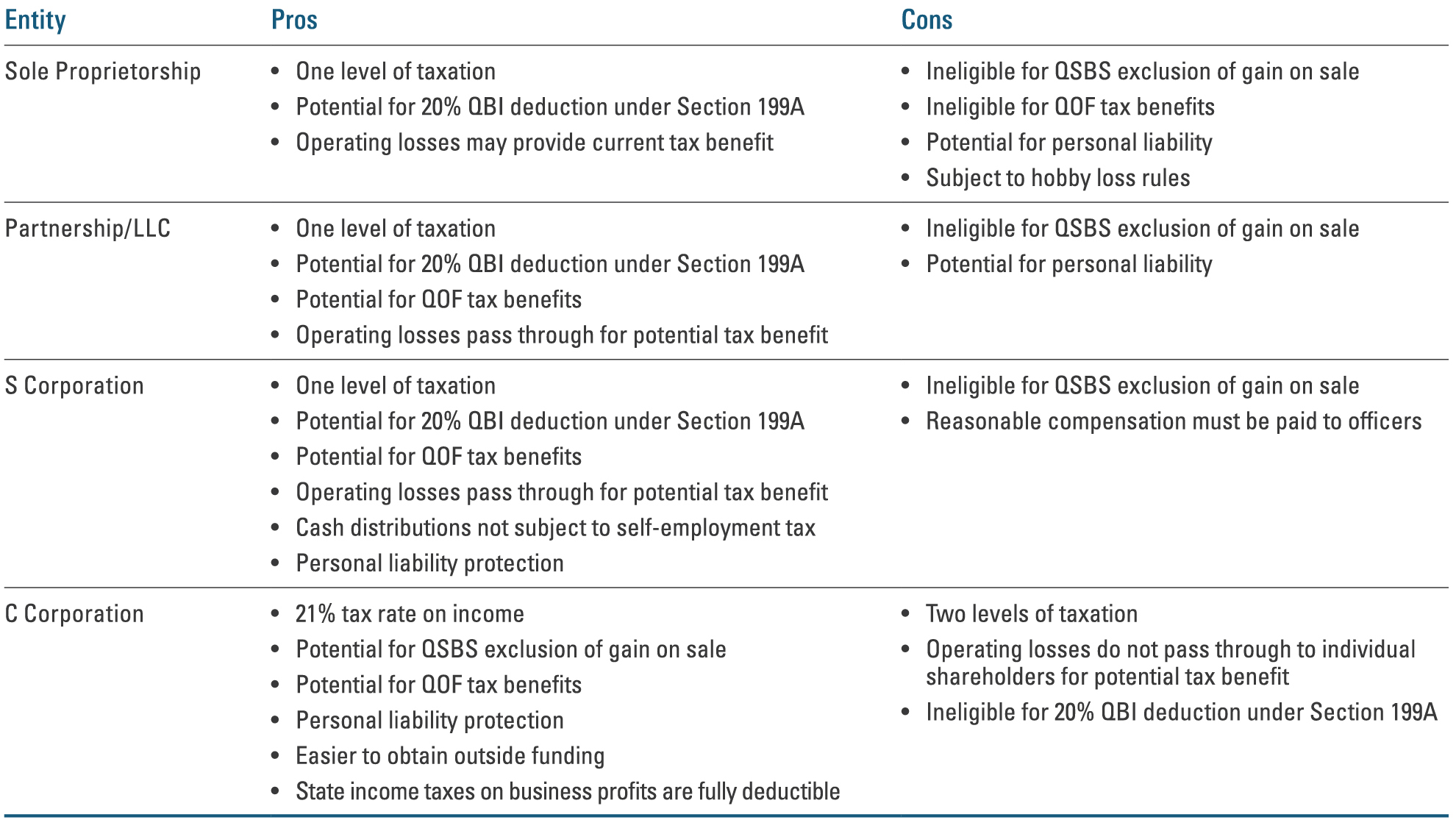
Comparing Business Entities From a Tax Perspective
This material is for your general information. It does not take into account the particular investment objectives, financial situation, or needs of individual clients. This material is based upon information obtained from various sources that Bessemer Trust believes to be reliable, but Bessemer makes no representation or warranty with respect to the accuracy or completeness of such information. The views expressed herein do not constitute legal or tax advice; are current only as of the date indicated; and are subject to change without notice. Forecasts may not be realized due to a variety of factors, including changes in economic growth, corporate profitability, geopolitical conditions, and inflation. Bessemer Trust or its clients may have investments in the securities discussed herein, and this material does not constitute an investment recommendation by Bessemer Trust or an offering of such securities, and our view of these holdings may change at any time based on stock price movements, new research conclusions, or changes in risk preference.